

Direct light is often described as harsh. Indirect light as comfortable.
It is a convenient distinction. But for good lighting design, it is far too simple.
The question is not which of the two types of light is fundamentally better. What matters is the task light needs to perform within the space – and how direct and indirect light are balanced against one another.
Direct light travels from the luminaire straight to the surface, object or area that needs to be illuminated.
It can be precise. Efficient. Contrast-rich. Directional.
Indirect light first hits a ceiling, wall or another surface and only enters the space after being reflected.
It can feel soft. Brighten large surfaces. Distribute brightness through the room. Reduce contrast.
That is exactly why direct light can be excellent. Or uncomfortable.
And indirect light can make a room feel remarkably calm. Or completely flat.
Quality does not come from the category – it comes from the design.

Work surfaces, tables, exhibits, vertical surfaces or specific architectural elements can be illuminated selectively.
Ceilings and walls can become large luminous surfaces that distribute brightness more broadly throughout the room.
More direct light strengthens direction and contrast. More indirect light reduces contrast and raises the overall level of brightness within the space.
This is exactly what makes combined systems so interesting.
At Peak Ace, the direct and indirect components can be controlled separately. The space therefore does not need to maintain the same lighting balance in the morning, during focused work and at an evening event.
The luminaire stays the same. The hierarchy changes.
Light can be directed precisely to where a visual task takes place.
Art, products, materials or architectural elements can be visually separated from their surroundings.
Directional light can make routes, entrances and spatial focal points easier to read.
Light and darkness can be used deliberately to develop spatial hierarchies.
Large reflective surfaces create a broader and more distributed level of brightness.
A dark ceiling can feel visually heavy. Brightening the ceiling changes the entire distribution of brightness within the room.
Indirect light can soften strong brightness differences and create calmer visual transitions.
Combined with targeted accents, indirect light can form a calm visual background.
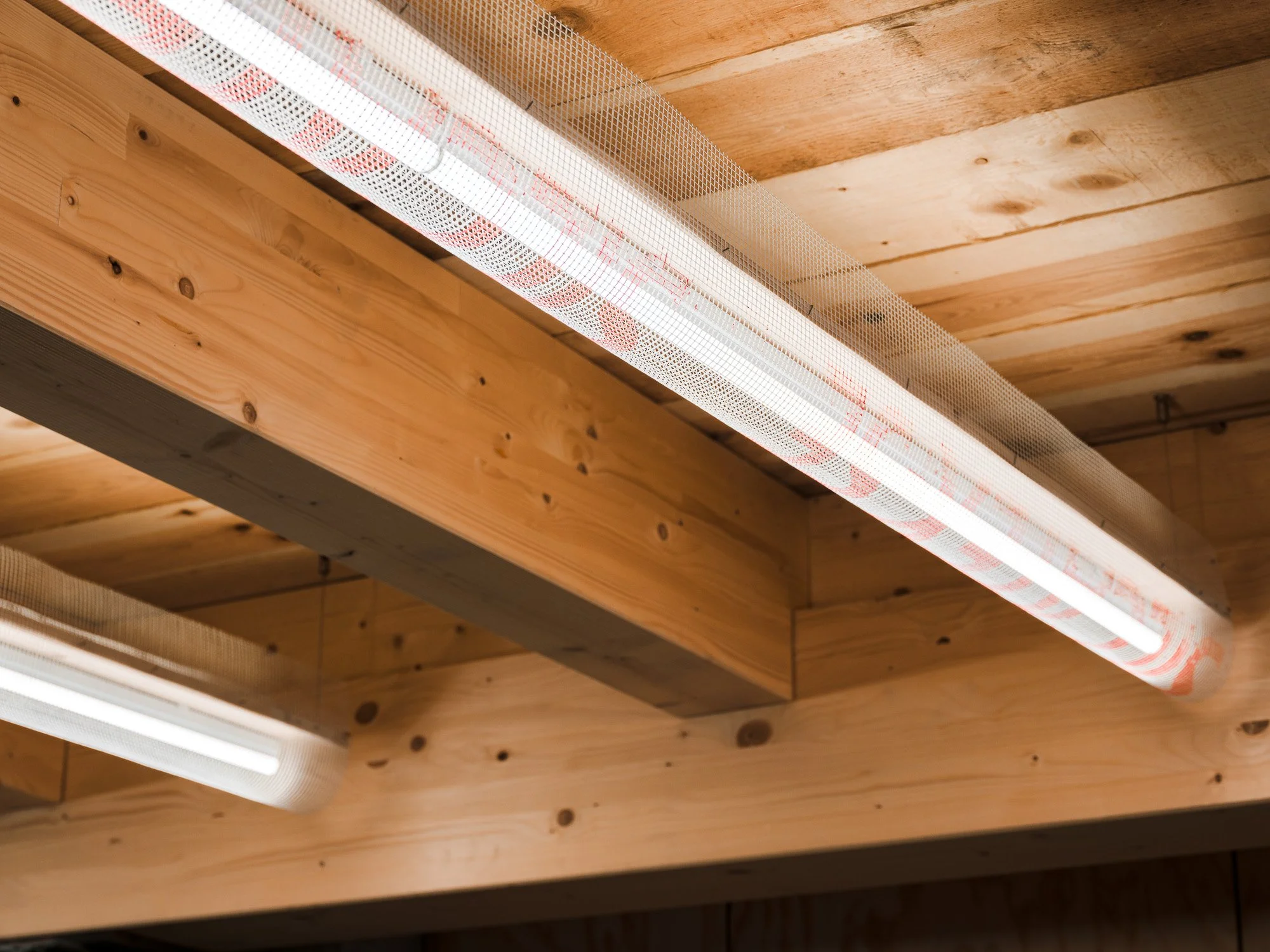
At Impact Hub Berlin, a project-specific pendant luminaire was developed for the office areas.
Its construction combines reused timber elements with LED strips and diffuse linear light sources.
The principle is simple:
- indirect light is directed upwards onto the timber structure and ceiling plane
- diffuse direct light provides illumination below
- a textile material on the underside helps reduce disturbing glare
The decisive point is not simply that both types of light are present.
What matters is that each has a clearly defined task.

What matters is how direct light leaves the luminaire.
The light source itself may be hidden.
But the illuminated surface can still become very bright.
A white ceiling directly above a powerful linear light source, for example, can become a large luminous surface. If it sits within the field of view or is reflected in a screen, even indirect light can become visually disturbing.
The light source disappears – its luminance does not.
Indirect lighting therefore also needs to be designed: with distance, output, surface properties, geometry and viewing direction in mind.
This is surprisingly easy to underestimate during the early design phases.
A light surface reflects considerably more light than a dark one.
Matte, textured and glossy materials distribute reflected light differently.
If the light source is too close to the surface, hotspots can appear instead of an even wash of light.
Beams, coffers, coves and ceiling level changes alter the path of light and need to be considered as part of the design.
When light reaches a space via a reflective surface, some luminous flux is inevitably lost.
This makes indirect lighting less immediate than a direct solution.
But that does not mean: indirect = inefficient.
What matters is the system as a whole.
- How high is the reflectance of the surface?
- How efficient is the luminaire?
- How much light is actually required?
- Can good controls reduce energy consumption?
- Does the same indirect component perform several spatial functions?
Poor direct lighting can be equally wasteful if too many luminaires are installed or large areas are unnecessarily brought to high illuminance levels.
A deliberately low level of indirect ambient lighting creates a calm background and keeps the historic architecture visible.
Adjustable spotlights illuminate selected exhibits precisely and lift them out of the lower surrounding brightness level.
It is the contrast between background and accent that allows the eye to understand what should be seen first.
Especially in exhibitions, a lower ambient level can create effective accents with less light.

If ceilings and walls are similarly bright everywhere, the room can quickly lose its visual hierarchy.
If everything is illuminated evenly, it becomes less clear which areas are important and which are secondary.
Poor geometry can create visible LED points, sharp brightness edges or uneven gradients.
A dark or glossy ceiling behaves completely differently from a matte white surface.
The Covivio Office in Berlin demonstrates this particularly well.
Parts of the existing building receive only limited daylight. Long, indirectly emitting bespoke luminaires were developed there to brighten the ceiling structure and increase the perceived brightness of the space.
The indirect lighting is dynamic. Brightness and light colour can be adjusted for different situations.
In the meeting room, indirect cove lighting is combined with visible decorative pendant luminaires.
Here too, the solution is not indirect instead of direct – but several layers serving different tasks.


Direct and indirect systems become particularly interesting when both components can be controlled separately.
The direct component can be increased where visual tasks and work surfaces require more light.
Faces and spatial boundaries can become more important than maximum horizontal illuminance.
Direct and indirect components can be reduced differently rather than simply dimming everything proportionally.
Areas that were functionally important during the day can recede while other spatial focal points take over.
There is no universal percentage for the perfect balance between direct and indirect light.
A workplace has different requirements from a restaurant. A museum different requirements from a foyer. A low room different requirements from a large hall.
That is why the design does not begin with: 50 percent direct, 50 percent indirect.
It begins with the tasks of the space.
Work surfaces, displays, exhibits, stairs and other visual tasks may require a targeted direct component.
Ceilings and walls have a major influence on how bright a room feels overall.
Not every area needs to be equally bright. Differences can improve orientation and spatial hierarchy.
A luminaire that appears unproblematic while standing may become disturbing at a workstation, while seated or when looking at a screen.
Multifunctional spaces often benefit from controlling direct and indirect components separately.
With indirect lighting, the architecture itself needs to be understood as part of the optical system.
Shadows show direction. They reveal texture. They give objects depth.
A completely shadow-free environment, by contrast, can feel surprisingly flat.
Direct light becomes problematic when shadows interfere with use: for example, when hands cast shadows over a work surface or when faces are illuminated exclusively from above, creating strong shadows beneath the eyes and nose.
The task is therefore not to eliminate shadows. It is to control them.
For most architectural spaces, that is the wrong question.
Indirect light can brighten a ceiling. Direct light can illuminate a table precisely.
Indirect light can create a calm background. Direct light can make an object stand out.
Indirect light can reduce contrast. Direct light can create exactly the contrast a space needs.
Good lighting design therefore does not try to make one type of light win.
It decides which task each type of light should perform.
Direct and indirect light integrated within one linear system, separately controllable and adaptable to different uses.
View project →Semi-bespoke Light Hacks combine indirect LED strips with diffuse direct light for office areas.
View project →A low level of indirect ambient light forms the background while direct spotlights selectively accentuate exhibits.
View project →Dynamic indirect lighting supplements limited daylight and is combined with additional direct and decorative layers.
View project →With direct lighting, light travels directly from the luminaire to the surface being illuminated. With indirect lighting, it first hits a ceiling, wall or another surface and is then reflected into the room.
No. Both have different strengths. Direct light is particularly useful for precise visual tasks and accents, while indirect light is effective for broad spatial and ceiling illumination. Good lighting concepts combine both according to the architecture and use.
No. A reflective ceiling or wall can also develop high luminance. Viewing direction, reflectance, distance and light output therefore need to be considered when designing indirect lighting.
No. Its effect depends strongly on optics, beam angle, diffusion, glare control, position and light output. Direct light can be designed to feel very soft and comfortable.
A combination is often useful. Direct light can illuminate work surfaces precisely, while indirect components brighten the ceiling and room. Glare control, viewing directions, daylight and the specific workplace situation remain decisive.
Indirect light involves additional losses through reflection. Overall efficiency, however, also depends on luminaire efficiency, surface properties, controls and the required lighting level. Indirect lighting is therefore not inherently inefficient.
Yes. In multifunctional spaces, however, it can be more useful to control both components separately so that the lighting balance can change for different uses.
The starting point should be the tasks of the space rather than fixed percentages. First define where precise light, spatial brightness, accents, orientation or contrast are needed. The appropriate balance between direct and indirect light follows from these requirements.
It needs the right distribution of light for its architecture and use.
Studio De Schutter develops architectural lighting concepts for workplace, hospitality, cultural, residential and public spaces.
Define lighting tasks. Develop contrast. Control glare. Combine direct and indirect light. Adapt scenes to use.
So that light does not simply fill the room – but works exactly where it is needed.

Contact Us:
