

The light source disappears.
A surface begins to glow.
That is where the strength of good indirect lighting lies.
The luminaire is not the focus. What matters is the light that walls, ceilings or architectural surfaces reflect back into the room.
It can soften boundaries. Reveal room height. Reduce dark edges. And create light without constantly exposing the source itself.
But indirect wall lighting does not automatically become good lighting simply because an LED strip has been hidden somewhere.
does not need
to glow.
The surface
can.
With indirect lighting, light does not travel directly from the luminaire to the eye or the task surface.
It reaches the architecture first.
A wall. A ceiling. A niche. A projection. A rear surface.
Only then is part of that light reflected back into the room.
This allows large surfaces to become luminous rather than individual bright points.
The reflecting surface effectively becomes part of the lighting system.
This might be an LED strip, a linear luminaire or another shielded light source.
Wall or ceiling reflects the light. Material, colour, texture and distance have a major influence on the result.
Instead of one dominant light source, a larger bright surface returns light to the room.
This is where the term becomes interesting.
In a real space, walls and ceilings are often impossible to separate completely.
Light spreads. It reaches transitions. It hits neighbouring surfaces.
And sometimes the ceiling is actually the more important reflecting surface.
An illuminated wall sits directly within the field of view. It can support depth, create orientation or give more presence to a particular surface.
When the ceiling becomes the reflecting surface, light can visually open the volume upwards. Particularly in tall or sloped rooms, this creates a different effect from light directed only downwards.
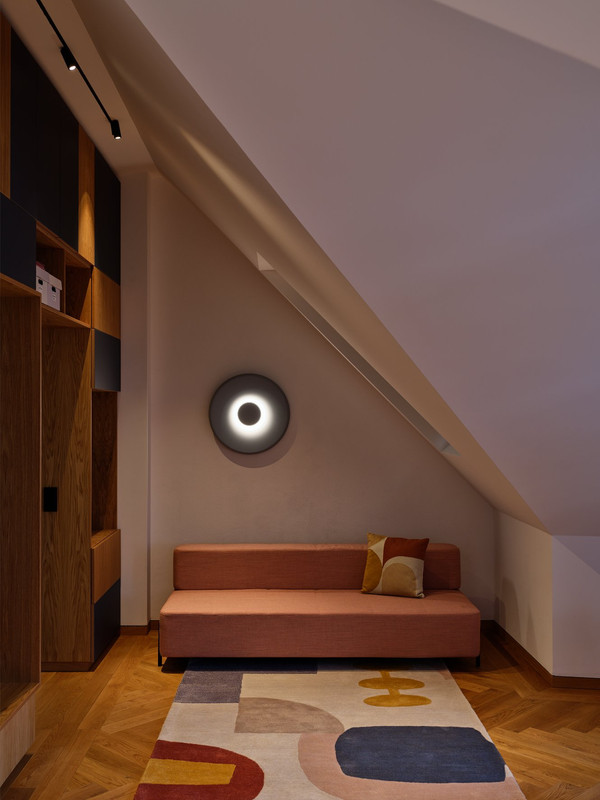
In the living area at Eisenbahnstraße, a circular pendant combines direct and indirect light.
Both components can be controlled separately.
The indirect component directs light upwards and helps make the more than 4.5-metre-high roof geometry spatially perceptible.
This is an important extension of the idea of wall lighting: indirect light does not work only by making a wall brighter.
It can also activate the ceiling and change how the entire volume of a room is experienced.
The light source is concealed within a cove and directs light onto an adjacent wall or ceiling surface.
Highly reduced solutions can allow light to emerge from a narrow architectural gap.
Lettering, mirrors, panels or other elements can cast light onto the surface behind them.
Light can be concealed behind shelving, furniture or other integrated elements to illuminate adjacent wall surfaces.
Indirect light at the transition between wall and ceiling can soften contours and make the geometry legible in a new way.
Particularly in tall spaces, upward-directed light can make the volume more perceptible without introducing another visible ceiling luminaire.
The two terms are often used interchangeably.
With wallwashing, the main objective is to illuminate a wall surface as evenly as possible.
The luminaire may still shine directly onto the wall.
With indirect lighting, the term describes the path of the light more strongly: another surface reflects the light before it becomes effective within the room.
An evenly illuminated wall is therefore not necessarily indirectly lit.
the façade
itself becomes
the light surface.
The principle does not stop indoors.
Outside, too, light can first reach architecture before becoming visible.
Behind lettering. Within façade niches. Beneath projections. Behind architectural elements.
This allows light to become closely connected to material, surface and building structure.
But especially outdoors, the goal should not be to make as much surface as possible as bright as possible.
Precision matters more than quantity.
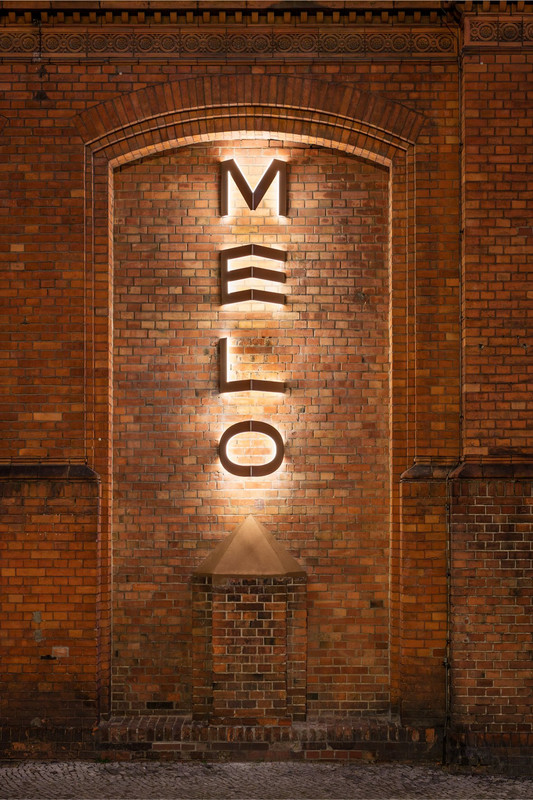
At MELO, the principle of indirect wall lighting becomes particularly clear.
For the historic façade of the Marie-Elisabeth-Lüders-Oberschule, Studio De Schutter developed a custom backlit sign.
The light sits behind the three-dimensional letters.
It first reaches the historic red brickwork and creates a warm halo on the surface.
That means it is not only the letters that become visible.
The texture, colour and depth of the existing façade also become part of the nocturnal image.
This is precisely why MELO is such a useful example: the reflecting surface in indirect lighting is never neutral.
Brick responds differently from white plaster. Concrete differently from timber. Natural stone differently from metal.
The material participates in the lighting.
only when
it is
needed.
At MELO, the lighting effect was not the only consideration.
Operation is part of the concept too.
The lighting is dimmable and time-controlled.
It is activated in the evening and switched off later, reducing unnecessary disturbance to the surroundings and limiting light pollution.
This is particularly relevant with indirect exterior lighting: a beautiful façade effect does not automatically justify leaving it on throughout the night.
The distance between the light source and the reflecting surface affects how softly and evenly the light spreads.
Colour, texture and reflectance change both the amount and character of the reflected light.
A light source may be concealed from one position and suddenly visible from another. That is why real sightlines need to be checked.
Maximum brightness is not the goal. Often, the relationship between the brighter reflecting surface and a calmer surrounding area matters more.
No.
A concealed light source can work with very little glare.
But hiding it alone is not enough.
An LED line may suddenly become visible from a seated position.
A glossy surface may reflect the source.
And an extremely bright wall within an otherwise dark room can create an uncomfortable contrast of its own.
Glare control comes from shielding, viewing angles, surfaces and brightness distribution.
Not from the word “indirect”.
luminaire
does not
automatically mean
an invisible
problem.
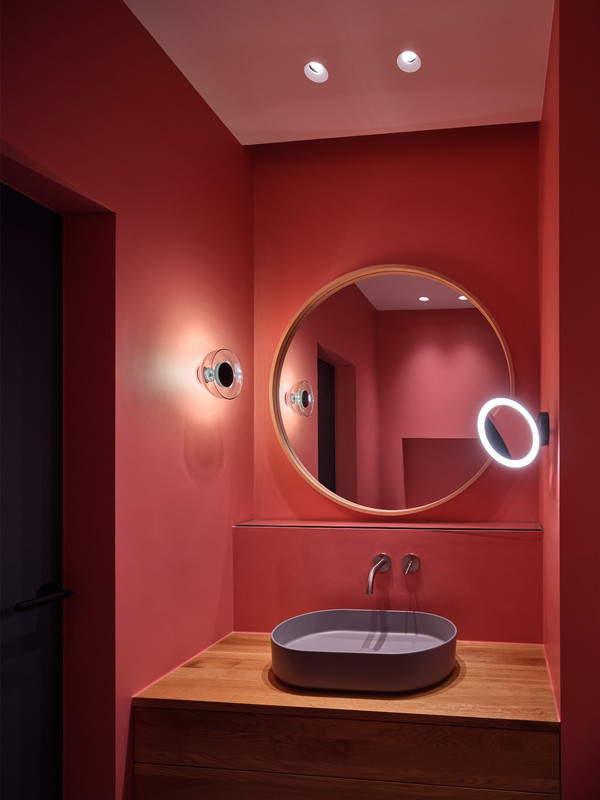
Indirect light does not always need to illuminate a large wall surface or a high ceiling.
It can also make sense in more compact spaces, especially when the light source should be closely integrated with the architecture.
In the bathroom at Eisenbahnstraße, cove lighting forms part of the spatial lighting concept.
Instead of building the entire lighting effect around a central ceiling luminaire, an indirect layer of light can complement surfaces and spatial edges.
This is where the principle becomes especially clear: indirect lighting is not a particular type of luminaire. It is a way of connecting light and architecture.
Not every wall needs to glow.
In fact, indirect light often becomes stronger when it is used selectively.
- At important room boundaries: when a wall should deliberately create depth or orientation.
- In tall spaces: when the ceiling and therefore the spatial volume should become more legible.
- In corridors and transitional areas: when orientation should be created with as few visible luminaires as possible.
- In living areas: when a quieter evening layer of light is needed alongside functional lighting.
- In bathrooms: when light can be integrated into niches, coves or architectural transitions.
- In hospitality projects: when materials, niches or architectural details should become more prominent.
- With built-in furniture: when the light source can be integrated naturally into the interior architecture.
- Outdoors: when façades, entrances or signage should be made visible with a controlled amount of light.
- Which surface should actually become more legible through light?
- Is the wall really the right surface, or would the ceiling work better?
- How does the existing material reflect light?
- Is the light source concealed from all relevant viewing angles?
- Is there enough distance for soft light distribution?
- Will individual LED points or unwanted zones of brightness become visible?
- How does the indirect lighting relate to direct light within the room?
- How does the effect change when dimmed?
- Which colour temperature works with the existing surface?
- Will the light source remain accessible for maintenance or replacement?
- Does the exterior solution create unnecessary spill light?
- Does the lighting need to remain active throughout the night at all?
- Starting with the LED strip instead of the surface: the reflecting surface is at least as important to the final result as the light source.
- Allowing too little distance: this can create hard zones of brightness or visible LED points.
- Ignoring the material: white matte plaster, dark brick, timber and concrete all reflect light very differently.
- Assuming “indirect” automatically means “glare-free”: viewing angles and reflections still need to be checked.
- Looking only at the wall: in many spaces, the ceiling may be the more interesting or even more important reflecting surface.
- Lighting everything indirectly: if every edge of the room glows, the principle can quickly lose its impact.
- Confusing wallwashing with indirect light: an evenly illuminated wall does not necessarily use indirect lighting.
- Using too much brightness: an indirect light surface does not need to be extremely bright to become spatially effective.
- Forgetting maintenance: concealed luminaires still need to remain accessible.
- Planning exterior lighting without time control: light should only be present when it is actually needed.
With indirect wall lighting, the light source is kept out of the direct line of sight as far as possible. The light first reaches a wall or adjacent architectural surface and is then reflected.
It can be very low-glare, but it is not automatically glare-free. Shielding, viewing angles, reflections and the relationship between bright and dark surfaces remain essential.
Light matte surfaces generally reflect a relatively large amount of light and allow for a more even effect. Dark or highly textured surfaces can also be interesting, but they change both the amount and character of the reflected light considerably.
Yes. Particularly in tall or sloped spaces, the ceiling can become a very effective reflecting surface. Indirect light can make the height and geometry of the room more visible.
Wallwashing primarily describes the even illumination of a wall and may be achieved with luminaires aimed directly at that surface. With indirect lighting, the light is first reflected from another surface.
Yes. Backlit lettering, façade niches, projections or other architectural elements can reflect light onto exterior walls. Spill light, brightness and operating times should be planned particularly carefully.
There is no universal distance. It depends on factors such as beam distribution, profile, luminous flux, geometry and surface characteristics. The specific construction should therefore ideally be tested with a mock-up.
wall needs
to glow.
Only the
right one.
It begins with the architecture.
Which surface should become visible? From where will it be seen? How does its material respond? And how much light is actually needed?
Studio De Schutter therefore develops indirect lighting together with walls, ceilings, materials and spatial geometry.
Sometimes the wall is the right surface.
Sometimes the ceiling.
And sometimes the best decision is to leave a surface deliberately dark.
Contact Us:
