

A good stairwell doesn't simply need more light. It needs the right light.
Stairs are among the most sensitive zones in any building: they serve as a circulation route, an orientation system, and in an emergency, part of the escape route. That's precisely why stairwell lighting determines not just atmosphere, but very directly — safety, legibility, and trust.
One step.
One shadow.
One wrong contrast.
And the space becomes unsafe.
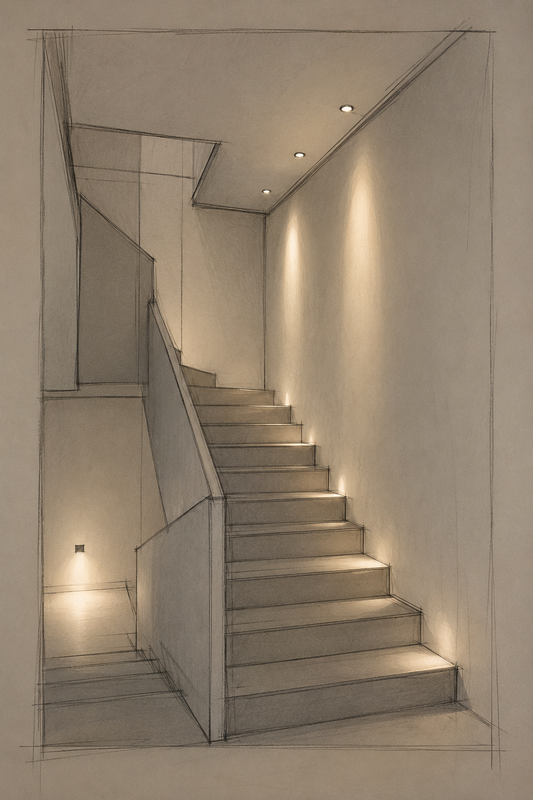
When people search for stairwell lighting, they rarely just want to know which fixture looks good. The questions are usually far more concrete: How bright does a stairwell need to be? Where should the light be positioned? How do you prevent glare? How do you keep steps, landings, and handrails clearly visible?
Good planning has to solve several levels at once:
- Making steps safe to read
- Avoiding glare
- Marking landings and changes of direction
- Supporting handrail visibility
- Keeping escape routes reliably identifiable
- Letting the architecture read as calm and high-quality
The most important shift in perspective: Stairwell lighting isn't decided by the fixture, but by whether the space can be read safely.
A stairwell must not consist of bright islands and dark voids. It needs a coherent gradation of brightness that guides users without blinding them.
A stairwell must make steps, landings, direction changes, and handrails visible enough to minimise the risk of missteps. This is especially important in internal stairwells with little daylight, in buildings with visitor traffic, or anywhere people don't know the route by heart.
Not just bright.
But legible.
Not just visible.
But safe.
For general use, many normative references to stairways commonly cite around 150 lux as a guideline. This figure isn't a universal prescription for every building, but it's a useful benchmark for when stair runs and landings become reliably recognisable.
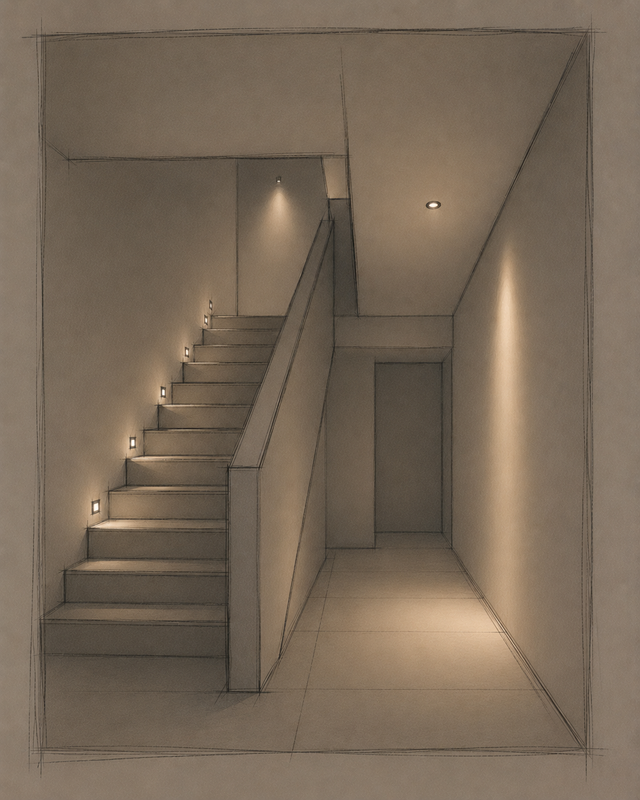
Stairwell lighting doesn't end with everyday use. Required stairwells can form part of main escape routes, and that's precisely why the lighting must also function in exceptional circumstances: calmly, unambiguously, and reliably.
For safety lighting along escape routes, a minimum value of 1 lux along the centreline of the escape route is frequently cited. If that's not sufficient for safe evacuation, more light must be provided. What matters isn't just the value itself, but also the uniformity of distribution.
A safe stairwell avoids:
- harsh light-to-dark transitions
- dark landing areas
- glaring light points in the field of view
- unclear step edges
- overlit safety signage
In an evacuation, light doesn't need to be beautiful. It needs to give direction, keep steps readable, and prevent people from losing their bearings at the wrong moment.
Comfort in a stairwell sounds soft, but it's highly functional. Good lighting isn't evaluated on lux alone — it also depends on uniformity, glare limitation, contrast, shadow, colour temperature, and colour rendering.
A well-lit stairwell reveals not just individual steps but the whole space: wall, stair run, landing, corner, handrail. Only then does a calm spatial legibility emerge that makes safety feel almost self-evident.
No harsh bright spots.
No black voids.
No hard shadows.
No spectacle at the expense of orientation.
Vertical surfaces are particularly important. When walls, handrails, and landing areas are factored into the lighting, a clear brightness frame emerges. The space feels less confined, movement becomes more predictable, and users can orient themselves more quickly.
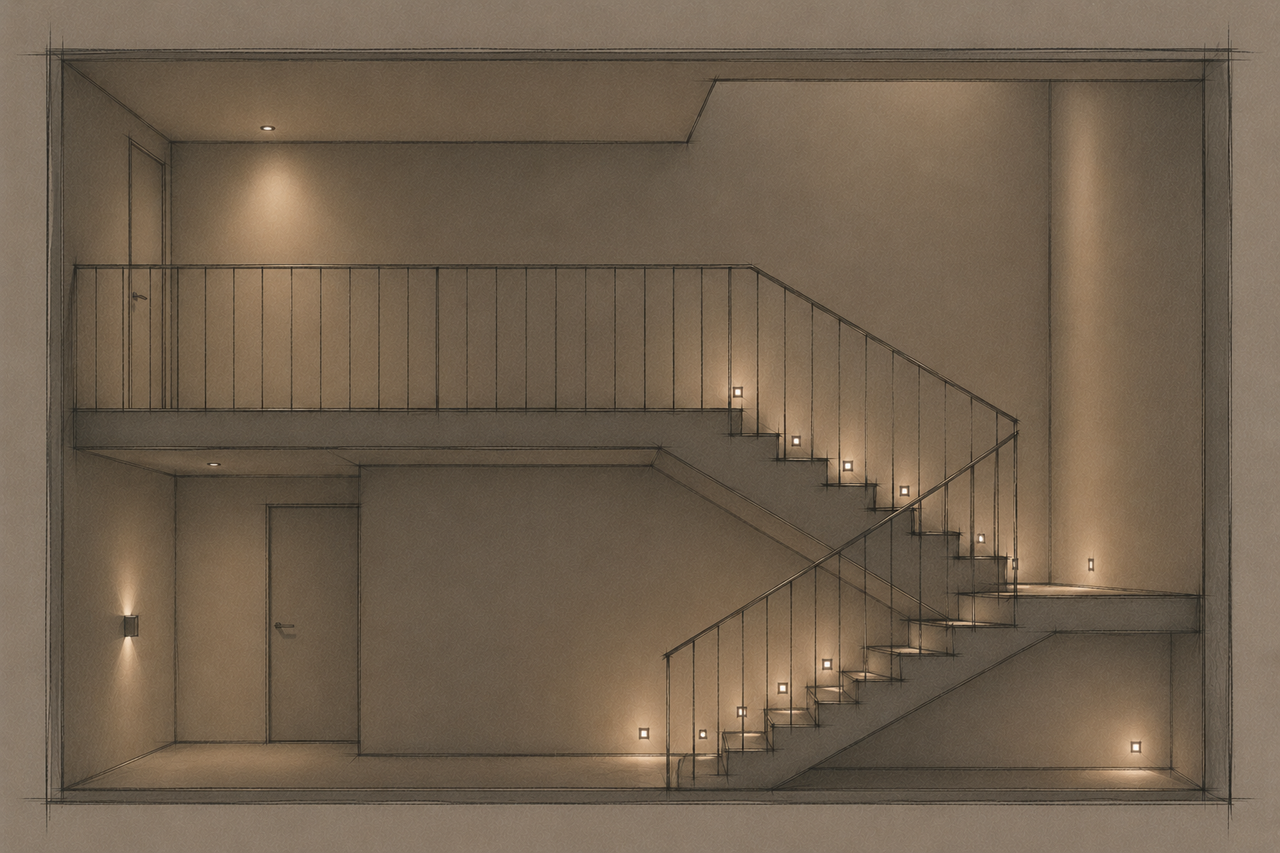
The mistake in many stairwells lies not in too little technology, but in too little architectural attention. Light cannot repair poor stair geometry. Only when geometry, handrail, material, and light work together does the sense of safety emerge that users notice immediately — usually without being able to articulate why.
In design terms, this means: a restrained, robust concept will outperform decorative lighting spectacle. Wall fixtures, linear light guidance along vertical surfaces, or cleanly shielded ceiling luminaires often work better than point-source downlights alone.
Good stairwell lighting works with:
- calm wall surfaces
- clear step edges
- visible handrails
- evenly lit landings
- glare-free fixture positions
- materials that receive light purposefully
The best solution is rarely the loudest. A stairwell needs light that guides — not light that pushes itself to the foreground.
In stairwells especially, it pays to think in layers. Everyday light provides comfort and orientation. Safety lighting takes over in the event of a power failure. Signage gives direction. Floor-level or linear light can add further legibility where the architecture allows it.
The key layers:
- Everyday light for use and comfort
- Safety lighting for emergencies
- Escape signs and route marking
- Handrail or wall guidance for orientation
- Sensors for efficiency and reliability
Motion detectors and presence sensors can help ensure light is only provided when it's actually needed. What's critical, however, is that the system never plunges the stairwell into darkness while people are still on the stairs. In residential buildings in particular, a warning function before switching off is advisable — for example, dimming down gradually or a brief signal.
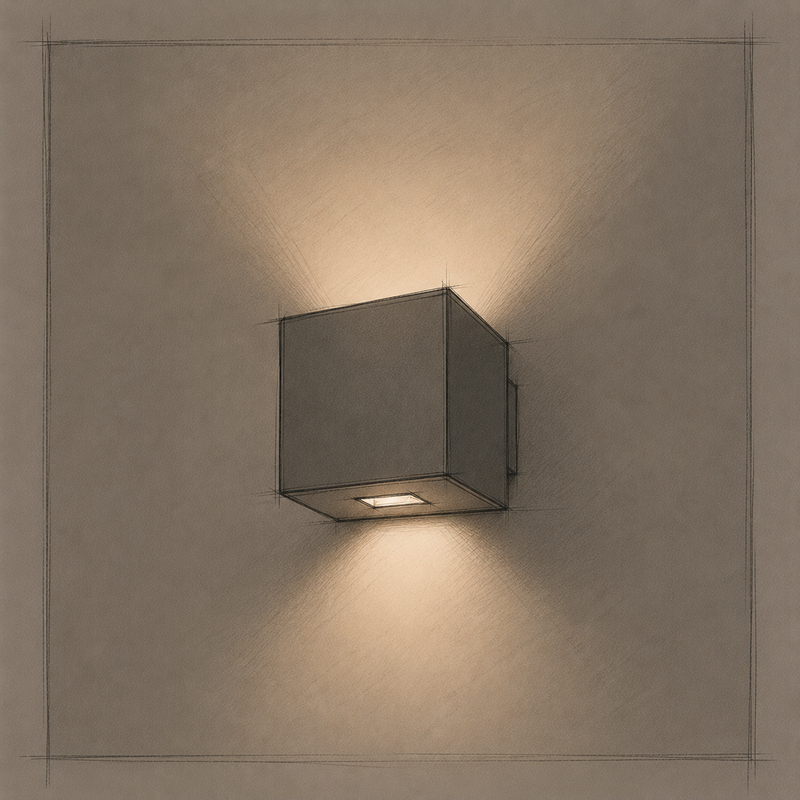
The best stairwell lighting is the kind you don't perceive as an effect, but as trust. It makes steps and landings clearly legible, keeps glare low, supports handrail and geometry, operates efficiently day to day, and remains reliable in an emergency.
Anyone who looks at lux alone is planning too narrowly. Those who bring safety, comfort, and architecture together get a stairwell that doesn't just feel code-compliant — it feels self-evident.
Steps must be legible.
Glare must stay low.
Landings need calm.
Handrails need visibility.
Escape routes need reliability.
The exact legal requirements always depend on the building type: workplace, residential building, public building, or special-use building. For specific projects, the use type, building class, federal state, and fire protection concept should therefore always be considered alongside the lighting.
Studio De Schutter develops lighting concepts for architecture, interiors, and safety-critical transitional zones where light is not treated as an afterthought, but as part of spatial orientation.
Good stairwell lighting doesn't just make a building brighter.
It makes movement safer, calmer, and more natural.
Contact Us:
