

When people search for meeting room lighting, they rarely want a simple list of fixture types. What they're looking for is a room that enables focused work, shows faces clearly, keeps presentations readable, and isn't tiring — either in person or on camera.
That's exactly what makes good meeting room lighting more demanding than it used to be.
Meeting rooms are no longer just spaces for in-person gatherings. They're workspaces, presentation rooms, video conferencing rooms, decision-making rooms. Sometimes all of that within a single morning.
One table.
Multiple sight lines.
A display.
A camera.
And a great many ways things can go wrong.
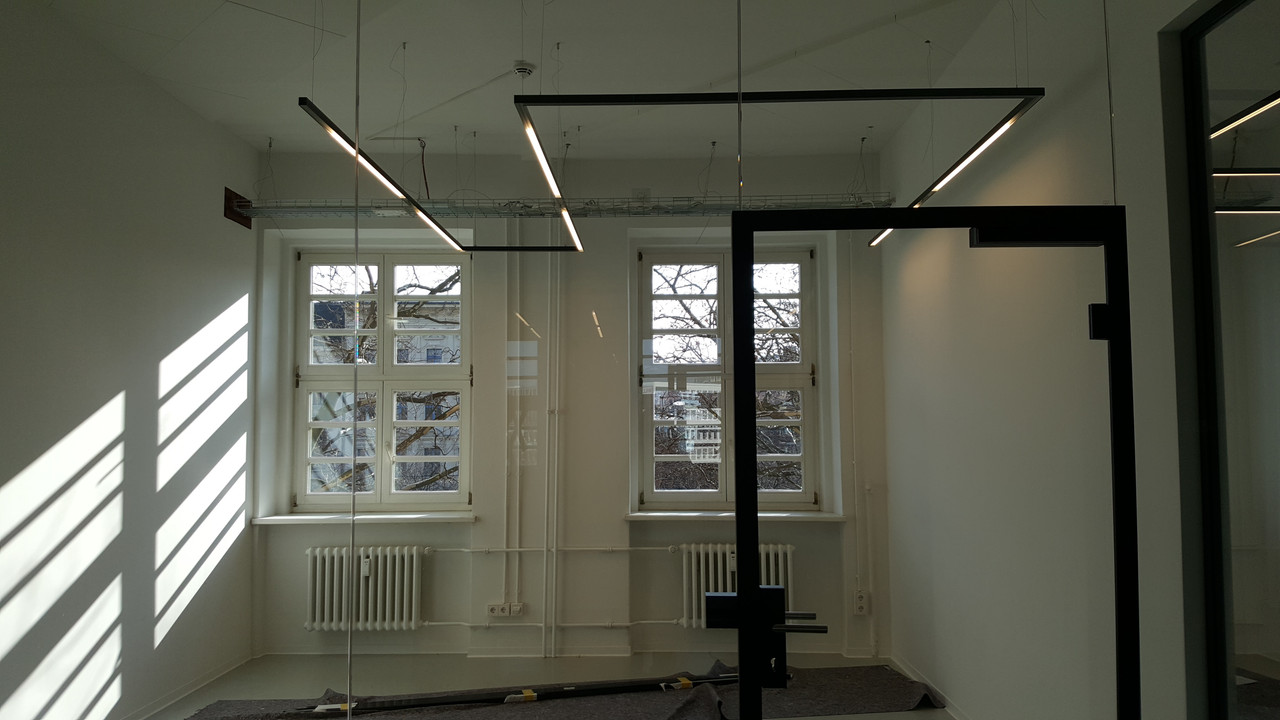
A good meeting room needs a balance of functional brightness, visual calm, and controlled light distribution. The goal isn't to make the room as uniformly bright as possible — it's to keep the right surfaces, faces, and sight lines comfortably visible.
Good meeting room lighting must work simultaneously for:
- conversations around the table
- presentations on screens
- notes and working documents
- hybrid meetings with a camera
- calm backgrounds
- glare-free sight lines
The most important shift in perspective: The fixture is not the concept. The concept is the interplay between space, surface, use, sight line, and screen.
Studies on office and work environments consistently show that light levels, glare, and light distribution influence how bright, calm, and high-quality a space is perceived to be. That's precisely why some meeting rooms feel surprisingly flat despite modern fixtures: the light is there, but it isn't working for the room.
Many meeting rooms are still planned as though even, overhead lighting solves the problem. Technically, that's straightforward. Spatially, it's often the beginning of the trouble.
Pure top-down light quickly creates shadows on faces, flattens expressions, and — depending on the fixture — can increase psychological glare. For classic office and screen workplaces, there's good reason that a strict glare limit applies; in DIN terms, this is typically UGR ≤ 19.
Horizontally bright.
Vertically weak.
Faces look tired.
The room stays flat.
What matters isn't just brightness, but how it's distributed. When the table is well lit but faces and vertical surfaces receive too little light, presence suffers — in the room, and even more so on camera in hybrid meetings.
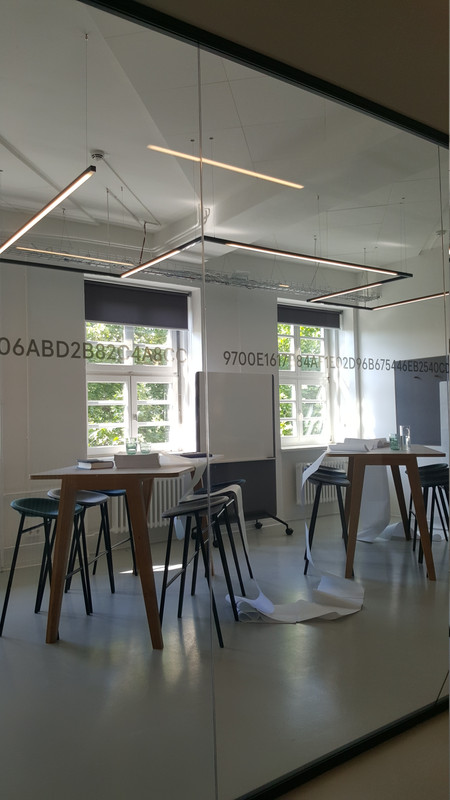
Large windows are almost automatically treated as a quality feature in design. And yes — daylight improves the spatial character of a room, makes spaces feel more alive, and can make the working environment significantly more pleasant.
But in meeting rooms, daylight can quickly turn problematic if it isn't managed. Direct sunlight, bright patches of sky, or harsh contrasts in the field of view can cause displays to glare, wash out whiteboards, render presentations unreadable, and make people around the table squint.
Good daylight requires control:
- effective glare protection
- controlled reflections on displays
- stable readability in changing weather
- good coordination between daylight and artificial light
- calm brightness ratios within the field of view
The better solution isn't to avoid daylight. The better solution is to manage it so the room functions reliably in sun, clouds, and presentations alike.
Meeting rooms in particular reveal whether daylight was conceived purely as an architectural gesture or as a genuine part of a resilient lighting concept.
What still feels acceptable in person can fall apart immediately in hybrid meetings. Uneven lighting, backlighting, dark faces, or shiny foreheads tend to look considerably harsher on camera than they do to the naked eye.
A good meeting room therefore has to serve two perspectives at once: the people at the table and the people on the screen. That doesn't mean lighting the room like a studio. It means placing light so that faces remain readable, backgrounds don't fall into shadow, and displays aren't competing with windows or fixtures.
You can see each other.
You can understand each other.
The room stays calm.
.jpg)
A meeting room isn't just a meeting room. Sometimes there's a discussion, sometimes a presentation, sometimes sketching, sometimes a digital pitch, sometimes just a small group on a video call. Light that works well for a conversation isn't automatically right for projection, screen work, or camera recording.
When everything runs through a single switching state, compromises are almost inevitable: too bright for presentations, too dim for notes, too contrasty for faces, or too flat for the room.
A simple scene logic is often enough:
- Conversation
- Presentation
- Workshop
- Video call
- Cleaning or preparation
Scenes aren't a technical gimmick. They're the logical answer to the fact that a meeting room today needs to be several rooms at once.
In many projects, the conversation starts with watts, form, and price — and light quality only comes up later. Yet in meeting rooms especially, colour rendering, flicker, dimming behaviour, and optical control are decisive.
Poor colour rendering makes skin tones look dull, materials look cheaper, and the whole room appear less precise. Temporally unstable light can create a sense of unease and is particularly problematic in rooms with displays, cameras, and movement.
What to pay attention to:
- good colour rendering for skin tones and materials
- low-flicker or flicker-free light sources
- clean dimming without jumps
- fixture positions with controlled glare
- calm backgrounds for video conferencing
.jpg)
A good meeting room doesn't need a spectacular lighting scheme. It needs a resilient balance: minimal glare, controllable daylight, readable displays, friendly faces, calm backgrounds, and light sources whose quality holds up beyond the spec sheet.
The order makes the difference:
- Understand the use cases and meeting formats
- Think about table, camera, display, and window together
- Check for glare and reflections early
- Plan for faces and vertical surfaces from the start
- Keep the scene logic simple
- Don't leave light quality decisions until the end
The best meeting rooms rarely look "lit." They simply feel clear. You can concentrate. You can see each other well. The screen works. Nobody is squinting. And the room stays composed even when a regular meeting turns into a hybrid call in ten seconds.
Studio De Schutter develops lighting concepts for workspaces, meeting rooms, office projects, and hybrid-use situations where light is not treated as an afterthought, but as part of the spatial function.
Good meeting room lighting doesn't make meetings more spectacular.
It makes them clearer, calmer, and more usable.
Contact Us:
