

Practice lighting – light that builds trust
Light plays a central role in publicly accessible spaces, as it is closely connected to emotion. It welcomes, guides, and calms – and often determines within the first few seconds whether people feel comfortable and well oriented. Light is not just illumination, but communication. It mediates between function and emotion, between precision and atmosphere. Good lighting creates orientation without being intrusive. It makes spaces appear larger, clearer, and warmer, supports focused work, and enhances the well-being of visitors and staff. At the same time, it expresses the attitude of a place: care, openness, and trust.
At Studio De Schutter, we understand light as a design language that connects function, architecture, and perception. The focus is not solely on efficiency and standards, but on what is felt without being named: calm, trust, and professionalism.
„Light is not what you see first — it is what makes you feel oriented, calm and understood before a word is spoken.“
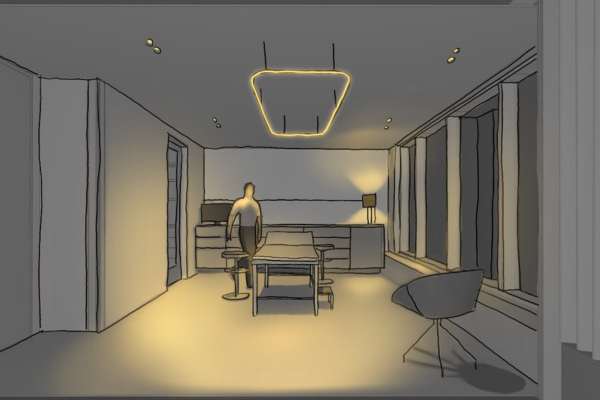
What we design light for
Publicly accessible interior spaces are at the same time workplaces, spaces for communication, and emotional microcosms. Lighting must support all of these levels simultaneously – from clear orientation to visual comfort in everyday use. Lighting concepts therefore take into account wayfinding and orientation, the identity and appearance of a practice, workplaces and visual comfort, as well as energy efficiency and sustainability.
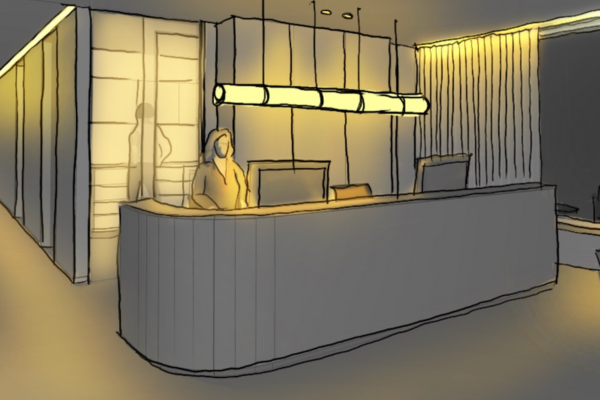
A publicly accessible space is never neutral. People enter it with different expectations – visitors, staff, guests, or customers – and all of these perspectives respond sensitively to light. Lighting is therefore understood as a design task that goes far beyond mere brightness. Each area, such as entrances, reception zones, waiting areas, and circulation spaces, receives its own lighting concept, tailored to use, atmosphere, and time of day.
Lighting in dental practices – where function meets well-being
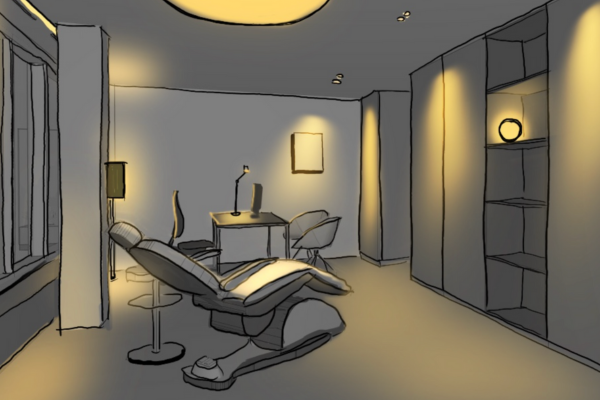
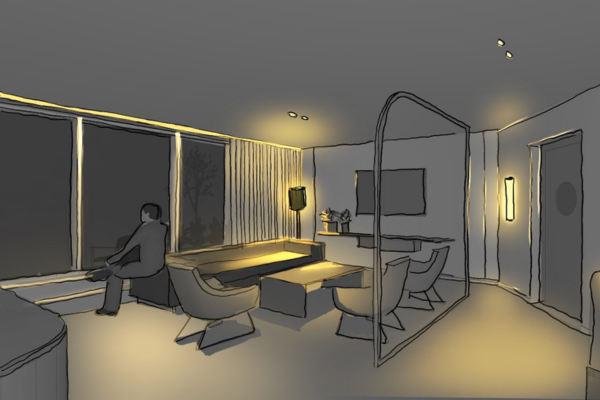
A dental practice is a sensitive space between precision and emotion. Highly precise work meets the natural tension of patients, which is why lighting must provide both technical accuracy and emotional relief. In the treatment areas, luminaires with high colour rendering and clear light distribution ensure safety and precision, while the surrounding zones are intentionally designed to be softer. Neutral white light in the focus areas is combined with warm white ambient lighting, allowing concentration to remain high without the space feeling sterile. Reception and waiting areas form the counterpoint, with soft shadows, diffuse light, and calm atmospheres.
Lighting in dermatological practices – naturalness and precision
In dermatological practices, light functions as a spatial and perceptual design element rather than a medical instrument. It supports visual clarity and orientation while contributing to a calm, natural atmosphere. Balanced light spectra, clear lines, and gentle transitions make spaces appear precise without feeling technical. Waiting and consultation areas are intentionally designed to be warmer and more diffuse, creating an environment that feels calming and composed. The focus lies on natural lighting qualities, reliable colour perception, a reduced and clearly structured lighting guidance, and an overall high level of comfort in consultation and waiting areas.
Lighting in general medical practices – light for encounter and structure
General medical practices are places of encounter. Light creates structure, intuitively guides people through space, and supports communication. Reception areas appear open and bright, treatment rooms clear and neutral, while corridors and waiting zones are designed to be warm and calming. This creates an atmosphere of reliability and humanity that is technically clear yet emotionally accessible. The lighting focuses on clear orientation for patients, bright and welcoming reception areas, neutrally designed treatment rooms, and warm zones for waiting areas and circulation spaces.
Sustainability
Lighting in medical practices is always a matter of responsibility. Ecological impact, long-term operation, and everyday reliability determine whether a lighting concept remains effective beyond the opening day.
Energy consumption, maintenance cycles, and system longevity are just as relevant as atmosphere and visual quality. Sustainable lighting means thinking in systems rather than in individual products. Modular structures, durable components, and repairable luminaires allow lighting solutions to grow with the practice instead of being replaced. Clear lighting scenes, efficient LED technology, and adaptable control systems keep concepts flexible over many years.
Modular, long-lasting lighting systems
Repairable and future-proof components
Efficient LED technology with precise light guidance
Concepts that grow with the practice and its workflows
Sustainability is not an add-on, but part of the design logic. Fewer luminaires, deliberately placed and clearly defined in their function, reduce complexity while creating greater clarity. The result is lighting that remains efficient, adaptable, and atmospherically consistent—designed as part of a cycle rather than a short-term solution.
Contact us to discuss how sustainable lighting strategies can be translated into a concept that fits your practice, your workflows, and your long-term goals.
