

Lighting Concepts for Rooms with High Ceilings
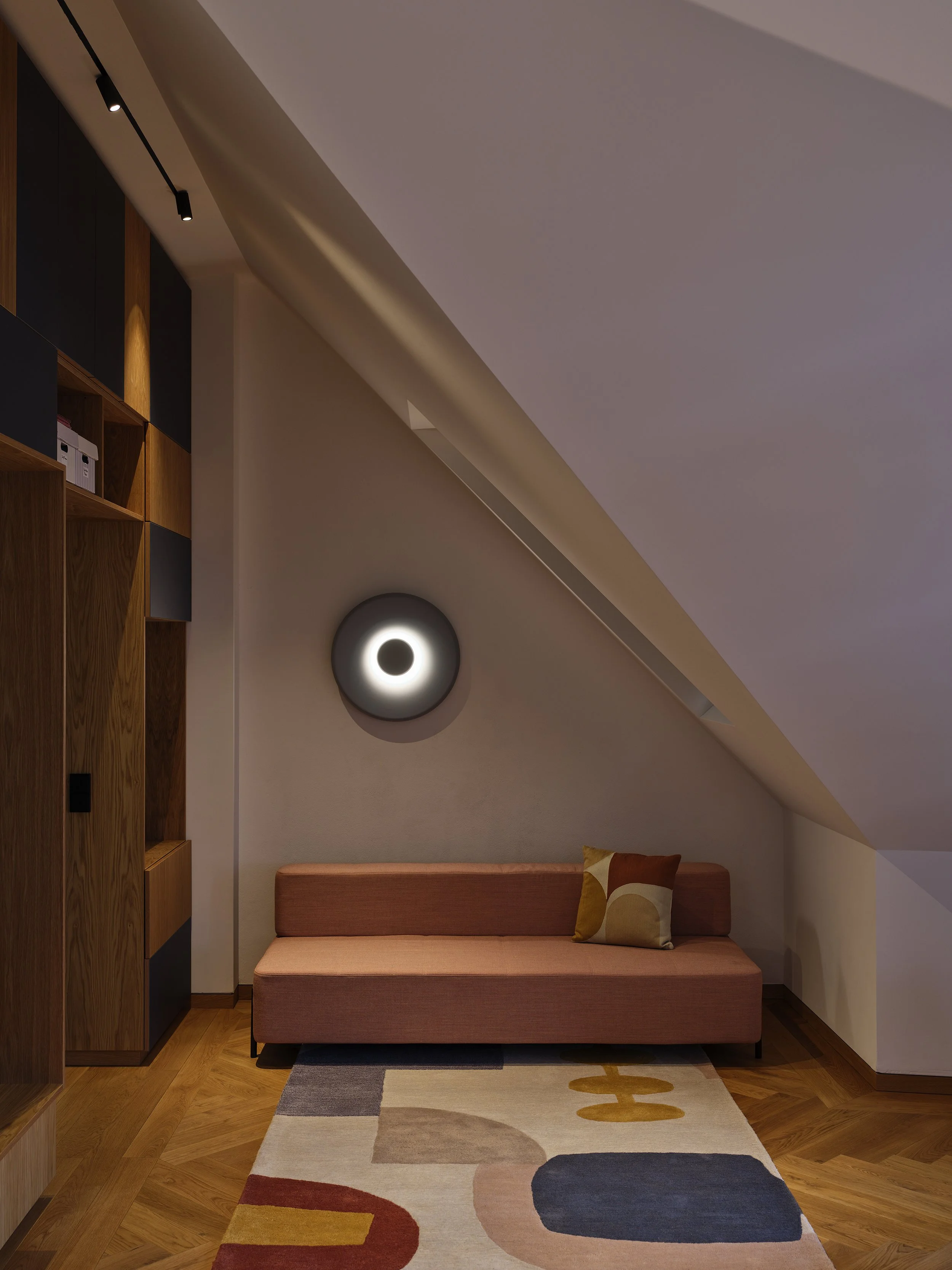
High ceilings change spaces radically.
They create generosity.
Air.
Presence.
Rooms feel more open, more representative, and often more architecturally impressive.
Yet this very height presents a particular challenge for lighting design. Light has to overcome distance while still remaining precise.
The greater the ceiling height, the more important it becomes to guide light intentionally. Without a clear lighting structure, much of the spatial volume remains unused — the room can feel empty, cold, or impersonal.
Many rooms with high ceilings appear surprisingly cool despite high-quality architecture. The reason is rarely the architecture itself. In most cases, what’s missing is a clear lighting strategy.
Often the attempt is simply to bring as much brightness as possible into the space. But brightness alone is not enough. What matters is where the light arrives, which surfaces it emphasizes, and how it structures the room.
Height alone does not create atmosphere. Light defines how a space is perceived. It can emphasize dimensions, balance proportions, and give the room a clear visual order.
Especially in spaces with high ceilings, light therefore becomes the actual design element of the room.
Why High Spaces Require Special Lighting Design
In traditional living spaces, ceiling heights usually range between 2.4 and 2.8 meters. In lofts, galleries, hotels, or representative residential buildings, heights can quickly reach four, five, or even eight meters.
This changes everything.
Light distributes differently. Shadows appear stronger. Surfaces react more sensitively.
Typical challenges:
• Light loses intensity the greater the distance to the usable level
• Ceiling surfaces often remain dark and feel heavy
• Accents disappear
• Spaces can feel surprisingly empty despite their size
The solution is rarely simply “more light.”
The solution lies in structure.
.jpg)
Pictures: Inselstrasse designed by Studio De Schutter

Thinking in Layers of Light
One of the most important strategies for spaces with high ceilings is working with different layers of light.
Not one light. But several.
A clear hierarchy creates orientation within the space. People do not perceive rooms only through brightness, but through contrasts, light distribution, and visual focal points. Different lighting layers help to shape this structure intentionally.
Typical layers include:
• General lighting for orientation and safety
• Vertical lighting for walls and spatial structure
• Accent lighting for furniture, art, and materials
• Atmospheric lighting for mood
These layers work together. They create depth. The space develops different visual zones that complement each other and make the large volume easier to read.
Especially in rooms with great height, this principle prevents light from being perceived merely as diffuse brightness. Instead, a clear spatial dramaturgy emerges: surfaces come forward, structures become visible, and important areas are deliberately emphasized.
A space with high ceilings needs light that does not only come from above. It needs light that reads the room — and consciously interprets its architecture.
Pendant Lights as Architectural Anchors
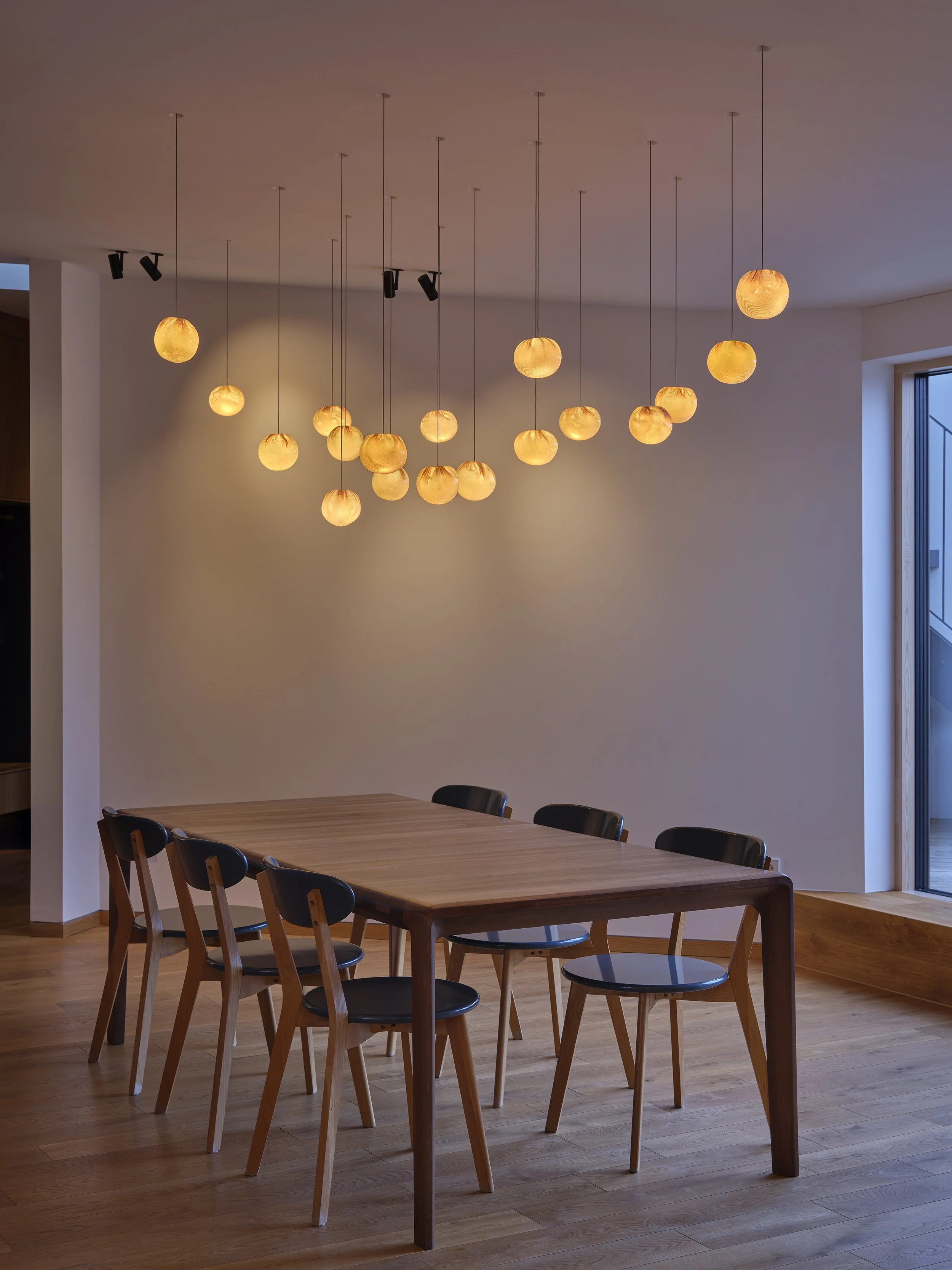
Pendant lights are one of the most effective tools in spaces with high ceilings.
Why?
Because they translate height.
They bring light closer to the level where people actually use the space while at the same time structuring the room. Instead of light remaining high up at the ceiling and feeling “lost” in the volume of the room, a visual connection is created between the ceiling, the spatial volume, and the areas where people actually spend time.
Especially in large spaces, pendant lights create a kind of spatial reference point. They define zones, guide the eye, and give certain areas a clear visual center.
Typical applications:
• above dining tables
• in lobby areas
• in galleries or stairwells
• above long conference tables
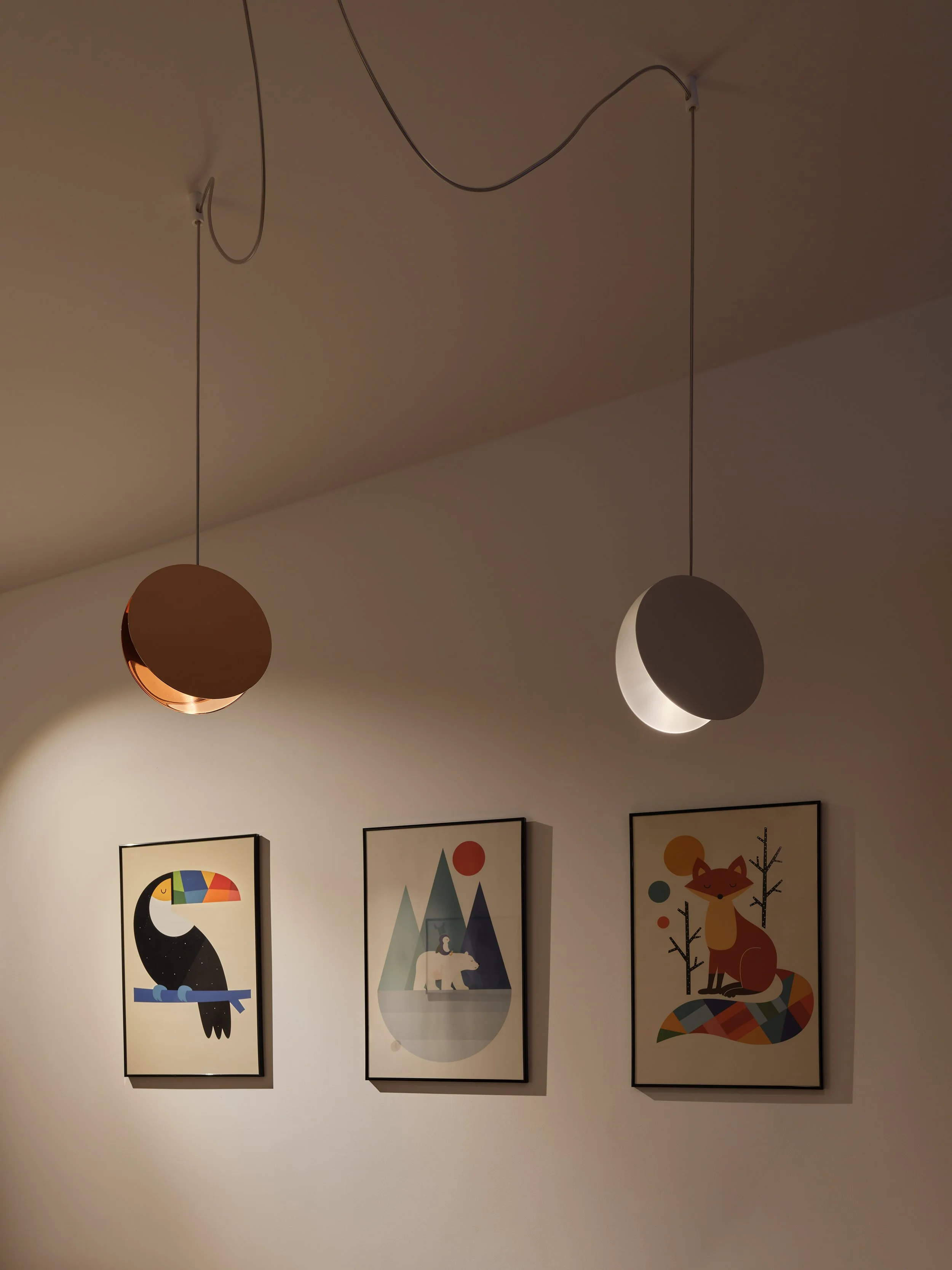
From a design perspective, pendant lights can take on very different roles. Some deliberately stand out and become a defining element of the space, while others remain more subtle and quietly support the architecture.
In many projects, pendant lights are intentionally grouped. Multiple fixtures form a lighting landscape that unfolds across the space and creates its own spatial dynamic.
This creates visual lines, repetitions, and rhythms that have a particularly strong effect in tall spaces.
Height is not hidden. It is staged.
Lighting Walls, Not Just Floors
A common mistake in rooms with high ceilings: the light is focused exclusively on the floor.
The result: the lower part of the room appears bright while the upper part remains dark. Almost as if the space were cut in half.
The eye stays on the usable level while large parts of the architecture disappear into shadow. Especially with high ceilings, this causes the actual spatial volume to be barely perceived.
Vertical lighting completely changes this picture.
Instead of illuminating only surfaces on the floor, the vertical dimension of the space is activated as well. Walls, materials, and architectural lines become visible. The room immediately feels more balanced and significantly more vibrant.
Typical techniques include:
• Wall washers that illuminate large wall surfaces evenly
• Grazing light that highlights material textures
• Indirect coves that brighten ceiling surfaces
These techniques ensure that light is not only used functionally but also creates spatial depth. Especially in rooms with large wall areas or distinctive materials, this produces a strong visual effect.
In representative spaces in particular, this creates a calmer and more refined atmosphere. Architecture, materials, and spatial proportions can fully unfold their effect.
Technical Aspects of High Ceilings
Beyond design, technical factors also play an important role.
Especially in spaces with large ceiling heights, luminaires must be selected carefully. The distance between the fixture and the usable level is significantly greater than in typical rooms. This changes the requirements for light output, beam distribution, and control.
Important criteria include:
• Beam angle for precise light distribution
• Luminous flux appropriate for the distance
• Glare control (UGR values)
• Color rendering for materials and artwork
The beam angle, for example, determines whether light is directed precisely onto specific areas or spread broadly throughout the space. With high ceilings, more precise light guidance is often required so that the light reaches exactly where it is needed.
Luminous flux also plays a central role. Luminaires must provide enough output to bridge the greater distance to the usable level without becoming uncomfortably bright or causing glare.
Typical solutions include:
• Narrow-beam spotlights
• High-performance LED systems
• Dimmable lighting controls
Energizing in the morning.
Calm in the evening.
In this way, light not only supports the architecture of a space, but also the natural rhythm of the people who use it.
Atmosphere Instead of Emptiness
Spaces with high ceilings hold enormous potential.
Yet without light, they often remain surprisingly neutral. Almost distant.
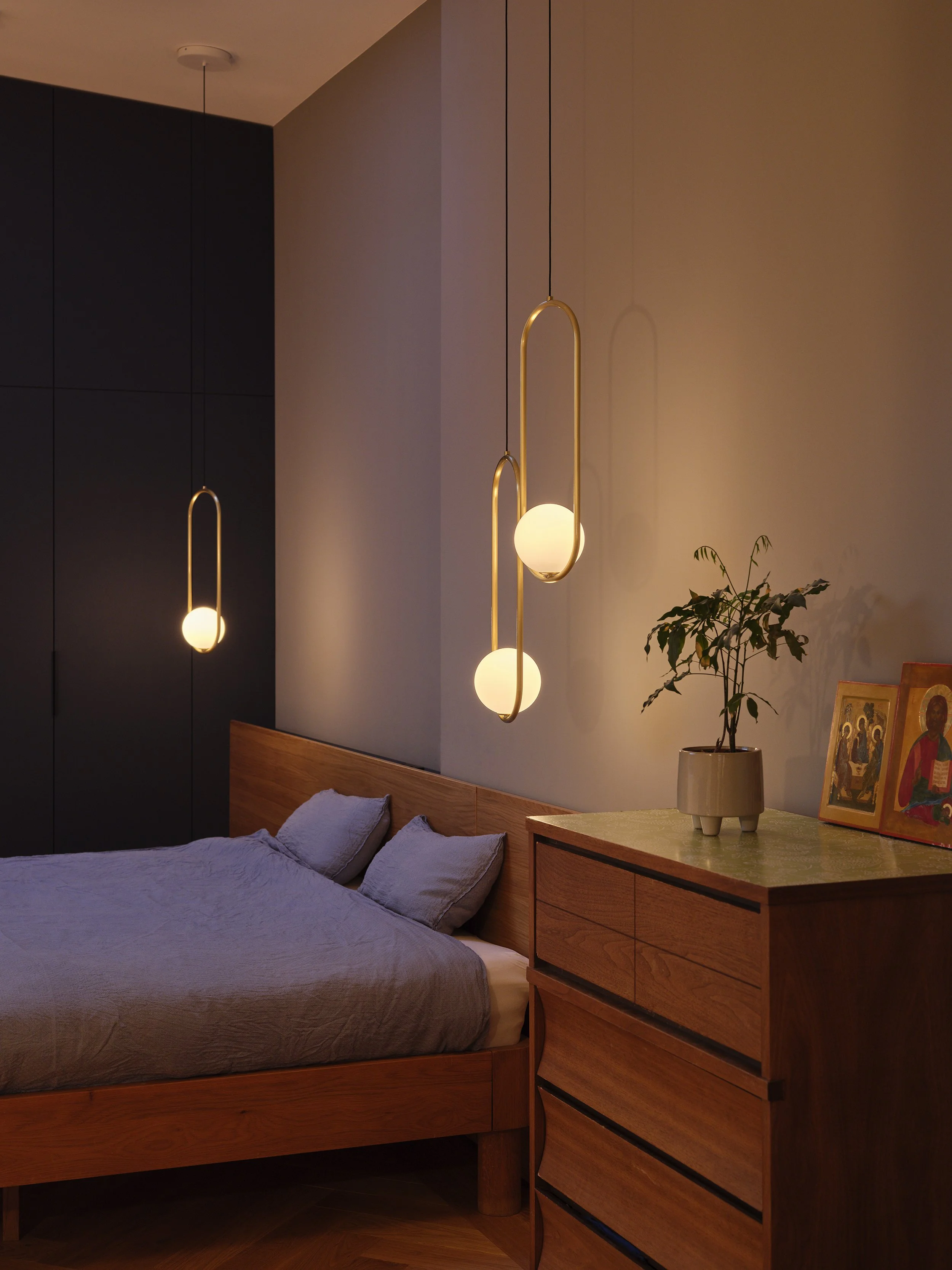
Good lighting design translates architecture into atmosphere.
It makes height perceptible. It guides the eye. It creates identity.

If you are planning a project with an exceptional ceiling height, we would be happy to support you in developing a tailored lighting concept.
Contact Us:
