

Old luminaires out. New LED luminaires in.
That is the obvious response to an outdated lighting installation.
But it is not always the best one.
An LED retrofit begins with a different question: What is actually outdated in the existing system – and what is still valuable?
Perhaps the housing is still in good condition. The position still makes sense. The integration into the ceiling would be costly to replace. The material has already been produced.
And perhaps the luminaire itself does not need to disappear.
Only its old technology does.
What still works technically, materially and architecturally does not automatically need to be replaced.
Light sources, drivers or other components can be selectively brought up to a contemporary technical standard.
New luminaires are introduced only where the existing installation cannot support a new use or the required flexibility.
If safety, light quality, economic viability or future requirements speak against reuse, replacement becomes the better decision.
at any
cost.
LED retrofit is often understood in very narrow terms: remove the old lamp, insert an LED replacement.
In professional lighting design, retrofit can go considerably further.
An existing luminaire can be technically assessed, opened, upgraded, given new controls and, where appropriate, visually transformed as well.
The aim is not to save as much of the existing installation as possible.
The important part is making the right distinction: What still has value? What limits the light quality? What needs to be modernised?
When lighting is refurbished, the first thing people often look at is future energy consumption.
Understandable. But incomplete.
A new luminaire has to be manufactured. Materials have to be processed. Components have to be transported. The old luminaire has to be removed.
If the housing, construction or installation position can still be used meaningfully, it may therefore make sense to retain those values within the building.
The most sustainable component may be the one that does not need to be manufactured again.
That does not mean: retain existing equipment at any cost.
A retrofit must work technically. It must deliver convincing light quality. It must be safe. And it must make economic sense.
A different quality.
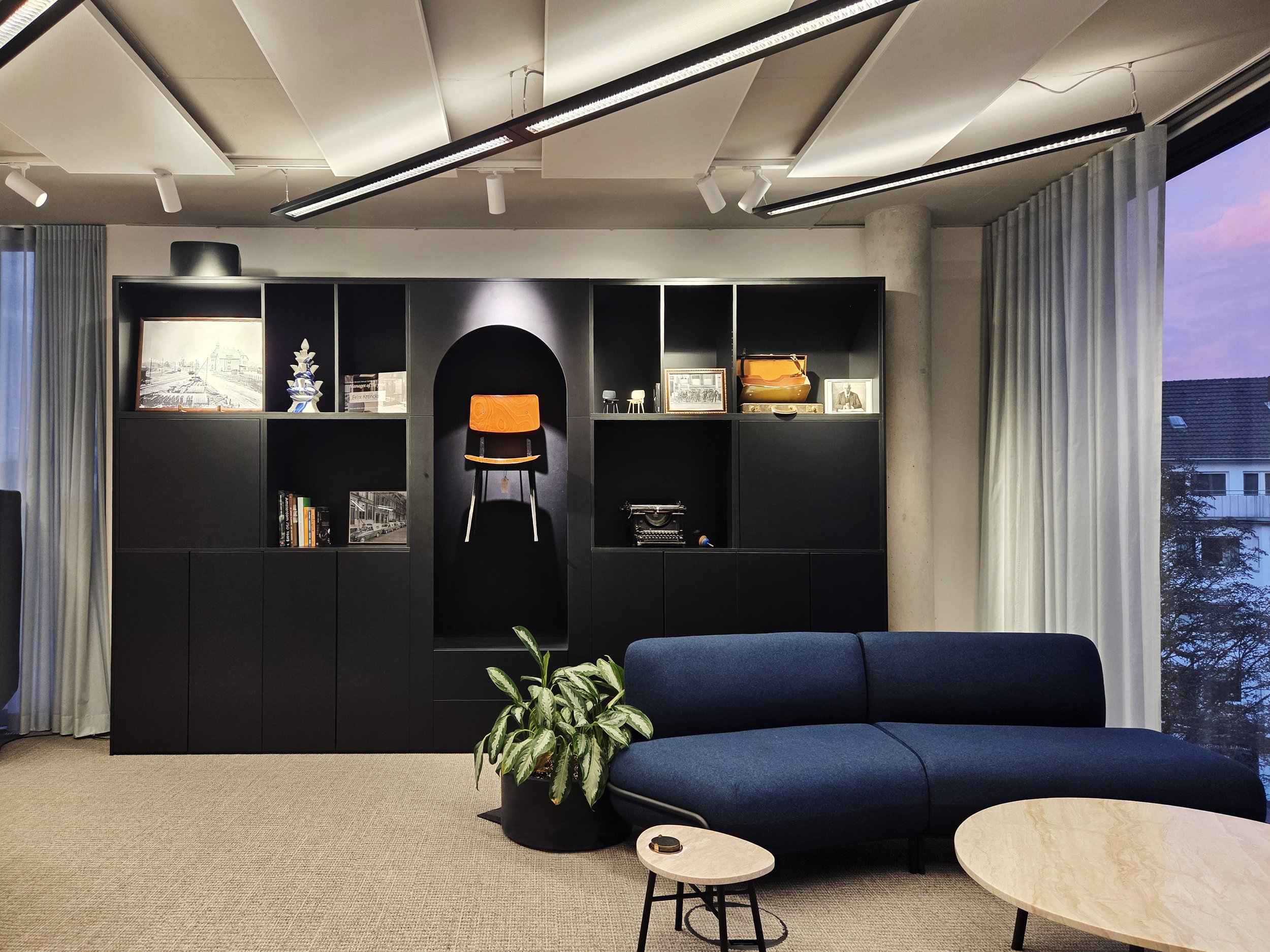
At the shared Düsseldorf location of Ahrend and Office Group, existing luminaires from the former office area were available for reuse.
Conventionally, they would have been easy to replace.
Studio De Schutter chose a different route.
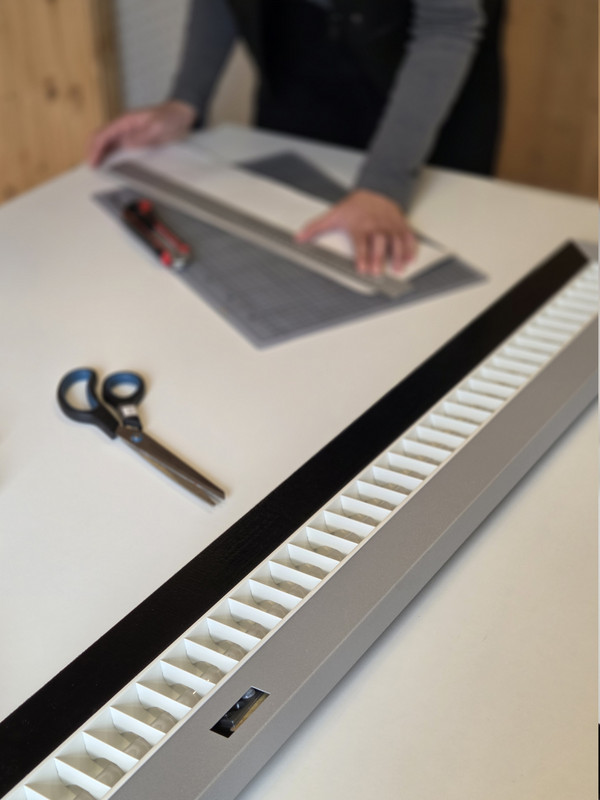
The luminaires were removed, dismantled, examined and reconsidered in different configurations.
3D models. Physical prototypes. Hands-on tests. Mock-ups.
The key question was not: How do we save this luminaire?
Instead: How far can we transform it before reuse no longer makes sense?
Intervene second.
Analyse construction, condition, position, existing technology and future use.
Which components still have technical, material or design value?
Use prototypes and mock-ups to evaluate light quality, integration and technical feasibility.
Introduce new components only where the existing system cannot perform the required task.
Do not treat retrofit in isolation, but connect it to scenes, use patterns and future adaptability.
does not have
to look old.
A common assumption about retrofit:
Afterwards, you can tell that something was “only reused”.
The Loop turns that logic around.
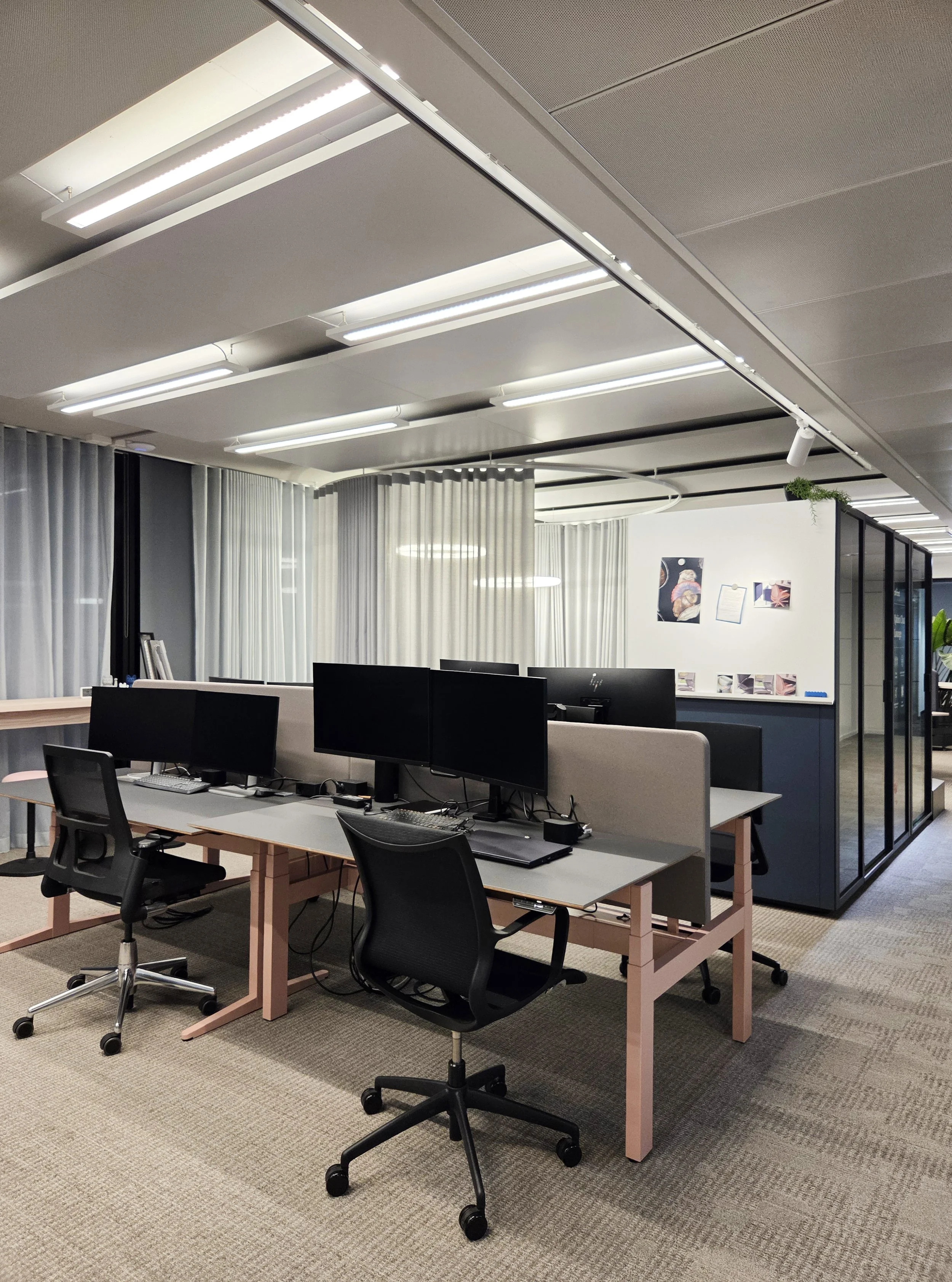
Some of the luminaires remained white and were integrated discreetly into the existing ceiling situation.
Others became black, were suspended slightly lower and arranged diagonally within the space.
The existing installation does not disappear.
It takes on a new design role.
Instead of permanent powder coating, a reversible wrapping solution was used for the black versions.
This means even their appearance can be changed again later, without replacing the luminaire itself.
Energy efficiency matters.
But it is only one layer.
A high-quality refurbishment should answer at least four questions at the same time:
- Energy: How can future electricity consumption be reduced?
- Light quality: Are colour rendering, flicker, glare and light distribution appropriate for current requirements?
- Material: Which existing components actually need to be replaced?
- Use: Can the modernised system respond to different situations and future changes?
That is why a retrofit is not automatically the cheapest technical solution.
It may instead be the smarter overall decision.
In older lighting installations, a large part of the problem often lies not only in the light source.
Luminaires may not be dimmable. Zones may be switched together. Different uses may rely on the same setting.
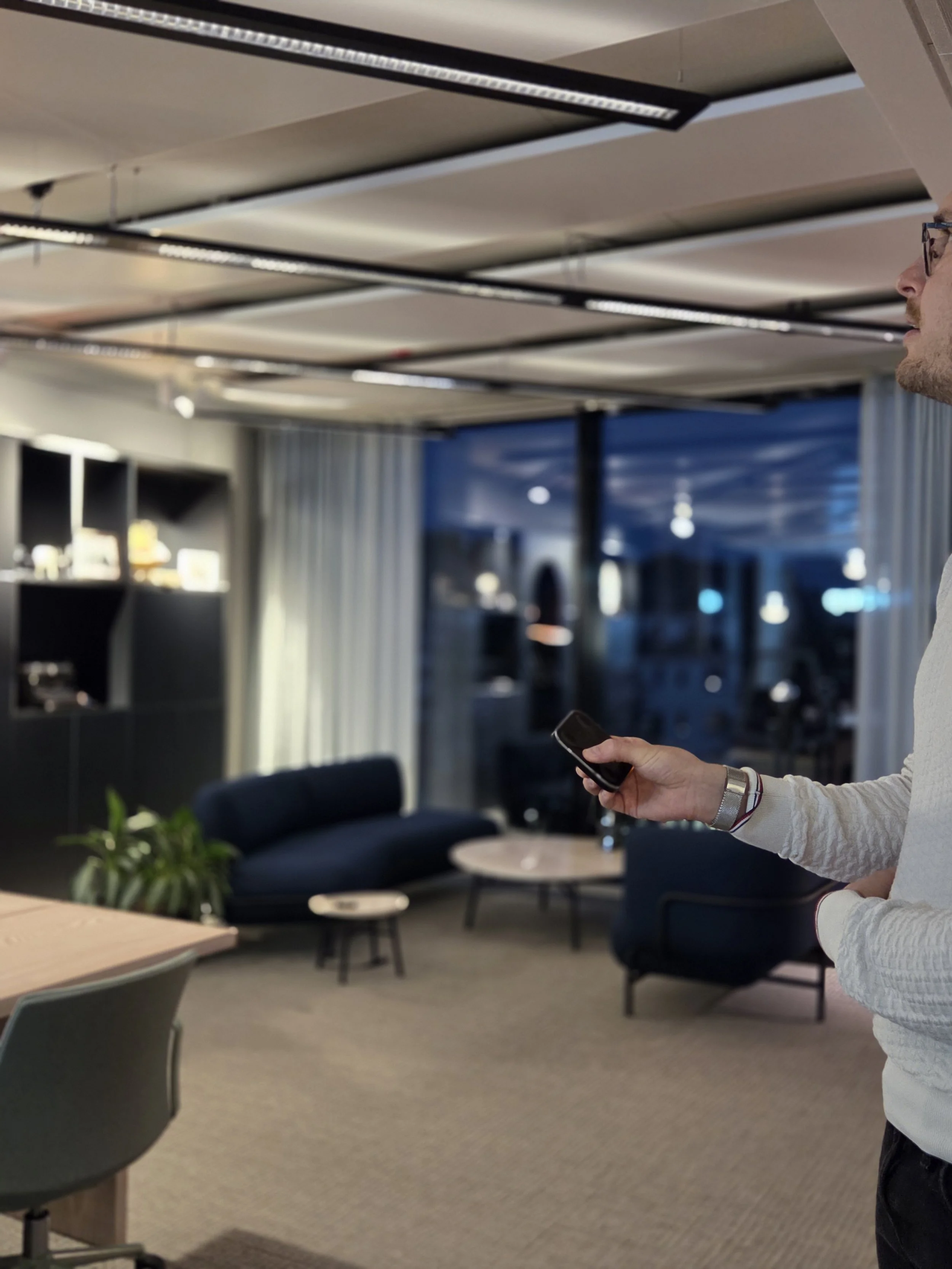
At The Loop, the modernised lighting was therefore connected to programmable scenes.
The same space can function as a workplace, showroom, consultation environment and event space.
This is an important retrofit principle: reusing existing hardware does not mean preserving existing patterns of use.
Not less performance.
compared with a complete new lighting installation.
including installation compared with the assessed complete new installation.
One point is important: these figures are not a universal retrofit promise.
They belong to this project.
In another existing installation, dismantling, modification, accessibility, quantities, required light quality or technical requirements may change the calculation completely.
When to replace?
- the housing and mechanical condition are still good.
- the existing positions suit the future use.
- a technical upgrade can be integrated sensibly.
- complete replacement would significantly affect the architecture or ceiling.
- the luminaires have material or design value.
- controls and light quality can be improved selectively.
- the existing condition creates technical or safety concerns.
- the luminaire positions are fundamentally unsuitable for the new use.
- the required light distribution cannot be achieved with the existing fittings.
- the conversion becomes disproportionately complex or economically unreasonable.
- maintenance and future replacement parts cannot be addressed sensibly.
This should not be underestimated, particularly in commercial projects.
As soon as an existing luminaire is technically modified, its suitability, electrical safety and lighting characteristics need to be assessed professionally.
Not every old luminaire is a sensible retrofit candidate.
And not every technically possible conversion is automatically a good lighting design solution.
The right question is therefore not: “Can we put an LED in here?”
It is: Will this result in safe, high-quality and long-term viable lighting?
check this list first.
- How old is the existing lighting installation?
- Which components are technically outdated – and which are not?
- Are the housing and mechanical construction still in good condition?
- Do the existing luminaire positions suit the future use?
- Can the required light quality be achieved through a retrofit?
- How will CRI, flicker, colour temperature and light distribution change?
- Can a contemporary control system be integrated?
- Which existing materials would be lost through complete replacement?
- How do retrofit and a new installation compare in terms of costs including installation?
- How complex are modification, testing and future maintenance?
- Where is the existing system insufficient and where are new luminaires genuinely needed?
- Will the solution still be adaptable in five or ten years?
LED retrofit means modernising existing lighting with LED technology. Depending on the starting point, this may range from replacing a light source to a more comprehensive technical upgrade of an existing luminaire.
No. Condition, safety, light quality, existing luminaire positions, modification effort, maintainability and economic viability need to be considered together. In some cases, a new luminaire is the better solution.
Suitable existing luminaires can in principle be modernised. Whether a specific luminaire can be sensibly converted needs to be assessed from both a technical and safety perspective.
It depends on the project. Energy consumption is only one factor; modification, components, installation, testing, controls and future maintenance also need to be considered. At The Loop, the cost saving compared with the assessed complete new installation, including installation, was 41.5 percent.
It can be more sustainable when existing materials and components are reused sensibly while still achieving contemporary technical and lighting quality. A universal answer is not possible.
No. The Loop shows that existing luminaires can also be reinterpreted visually. Some were integrated discreetly, while others became deliberately visible black diagonal elements.
Depending on the technical solution, a modernised luminaire can also become part of a new control concept. At The Loop, the retrofitted luminaires were connected to programmable scenes.
project does not
need new luminaires.
Perhaps it needs
a new way of
looking at the old ones.
Which luminaires can remain? Which technology should be upgraded? Where does modification make sense? And where is a new solution genuinely better?
Studio De Schutter approaches retrofit not as a compromise, but as a potential design strategy.
Bringing light quality, architecture, economic viability and resources into the same decision-making process.
Contact Us:
