

Gallery lighting: light as a silent curator
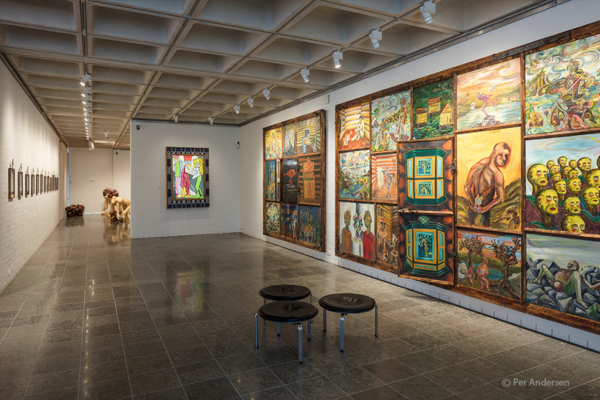
Gallery lighting determines whether art is merely visible – or truly moving. Light guides the gaze, shapes spaces, and influences how long people linger in front of a work. For us, gallery lighting means connecting architecture, curation, and perception in a way that creates an independent visual narrative.
What good gallery lighting should achieve
Professional gallery lighting combines emotional impact with technical precision. It supports the curatorial narrative without drawing attention to itself, while remaining flexible for changing exhibition layouts.
- High colour rendering (CRI 90+) so that colours and materials appear authentic.
- Directional light for clear accents on artworks and calm backgrounds.
- Glare-free lighting so the eye can move comfortably across the works.
- Flexibility through track systems and adjustable spotlights.
- Light colour: 3000–3500 K often works very well – warm enough for atmosphere, neutral enough for art.
- Colour rendering: At least CRI 90, ideally CRI 95+, especially for paintings and textiles.
- Angle of incidence: An angle of around 30° avoids harsh shadows and reflections.
- Distance: Do not place luminaires too close to the wall – this keeps the light distribution calm.
- Dimming: Dimming options allow for curatorial adjustments.
Gallery lighting for different art forms
Not every exhibition requires the same lighting dramaturgy. Photography, sculpture, and painting react differently to brightness, contrast, and reflections. A good lighting concept respects these differences and uses them deliberately.
Painting benefits from calm wall washers and targeted accents. Sculptures require modelling light that creates depth. Photography demands precise luminaire positioning to avoid reflections. And glass art? It reacts particularly strongly to backlighting, texture light, and transparency.
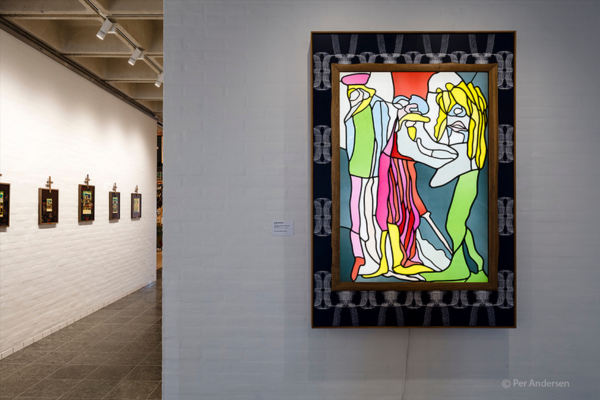
For the glass artwork “You live by the sword, you die by the sword,” Studio De Schutter developed a bespoke lighting solution that recreates the original exhibition impression of a window glow in a gallery in Copenhagen. The work, composed of antique coloured glass fragments, relies heavily on transparency, depth, and subtle imperfections such as air bubbles.
As the artwork was acquired by a private collector, the task was to reconstruct the lighting exactly as the collector had experienced it in the gallery. To achieve this, we analysed the daylight conditions throughout the day, reflections from surrounding façades, and the spatial integration of the window.
- An extremely flat lighting solution that fits within the artwork’s frame.
- Bluetooth-controlled, modular warm white LED elements.
- Uniform backlighting for a work over one metre wide.
- Fine adjustability for changing exhibition contexts.
Together with the artist, the team tested various lighting approaches to highlight structure, transparency, and glass imperfections. The final solution consists of a multi-layered, modular LED system that gently brings the work to life – independent of natural light conditions.
Studio De Schutter as a partner for gallery lighting
As lighting designers based in Berlin, we create gallery lighting that remains subtle yet tells a strong story. We translate curatorial intentions into lighting concepts that respond to perception, function sustainably, and immerse spaces in a distinct atmosphere.

If you are planning a gallery, an art space, or changing exhibitions, we support you from the initial idea through to fine-tuning – with lighting that makes content visible.
Double-click to edit...
