

Daylight is one of the most powerful yet most delicate resources in the office. It works quietly, almost unnoticed, and still decisively shapes how we perceive spaces, how long we stay focused, and how comfortable we feel. An office with well-guided daylight does not explain itself. You feel it. Spaces appear more open, clearer, calmer. Work feels less exhausting. Time seems to pass differently.
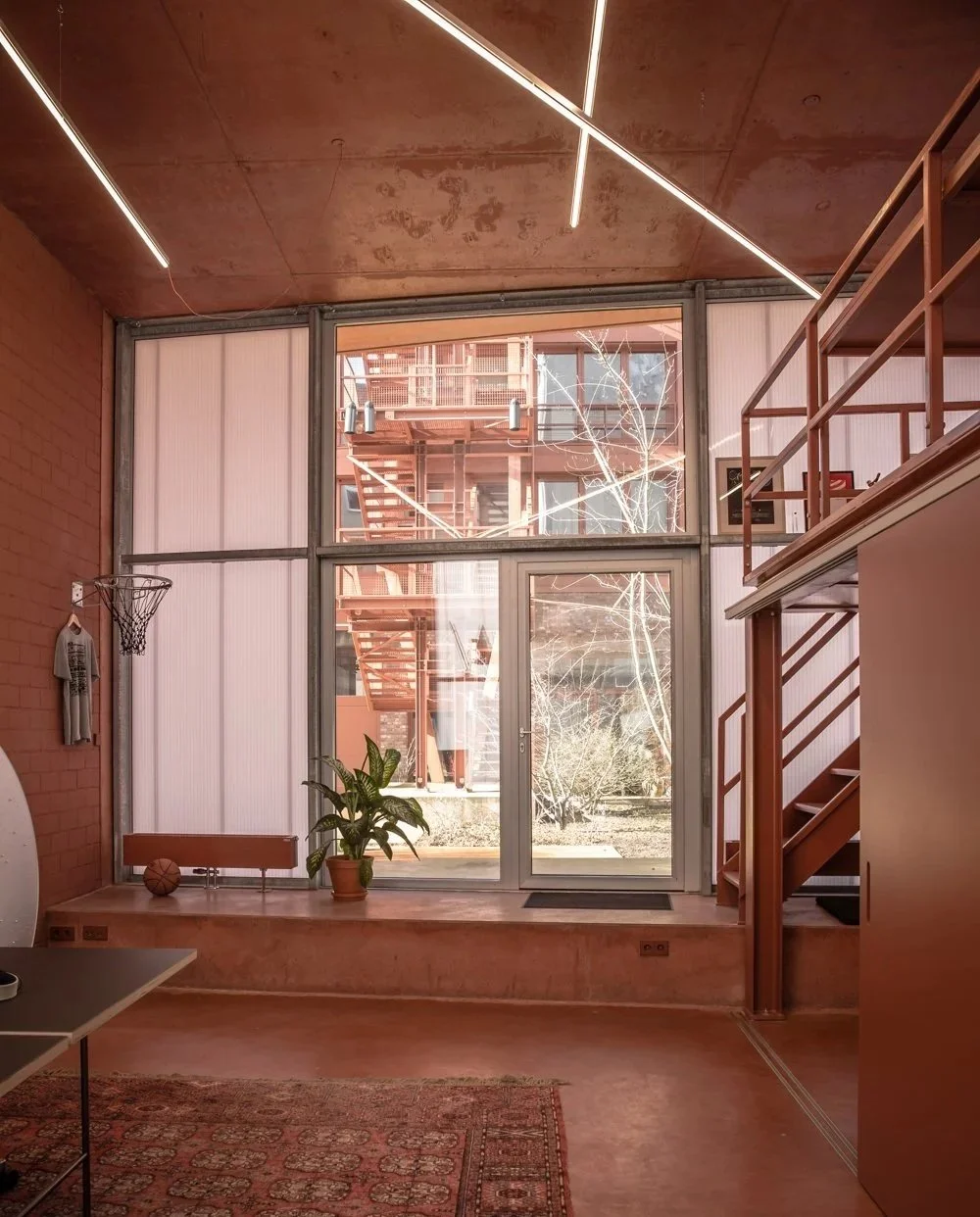
Designed by Studio de Schutter: Am Lokdepot Office, from IAM ONO.
Daylight as the Foundation of Space and Atmosphere
Natural light is not a decorative element. It is a spatial force. It shapes volume, makes proportions legible, and provides orientation. Where daylight is used well, a sense of self-evidence emerges within the space. You find your way intuitively. Sightlines are clear, and transitions between zones feel logical rather than constructed.
An office does not feel glaring or dark. It feels balanced. Architecture does not compete with light; it becomes readable through it. Light becomes part of the spatial concept, not a correction of it.
Daylight fulfills several spatial functions at once:
• It enhances the perception of depth and volume
• It supports orientation and intuitive wayfinding
• It visually connects interior spaces with their surroundings
• It defines zones without physical separation
• It creates calm through an even distribution of brightness
In this way, daylight becomes a quiet organizing principle within the space. Not as a short-term effect or visual statement, but as a structural foundation for atmosphere, spatial clarity, and architectural legibility. It orders, connects, and calms without pushing itself to the foreground, creating spaces that are intuitively understandable and feel right over time.
“Daylight shapes spaces before they are furnished. It gives architecture its legibility and people a sense of orientation and calm.”
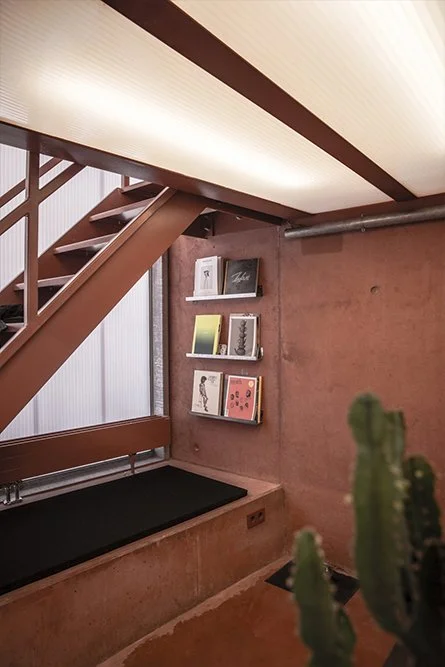
Daylight and Artificial Light in Dialogue
No workspace functions exclusively with natural light. What matters is not an either-or, but the interaction between the two. Artificial light takes over where daylight becomes weaker, changes, or is temporarily insufficient. It stabilizes the lighting atmosphere, balances contrasts, and ensures that spaces remain usable throughout the entire day.
Ideally, this transition is barely perceptible. Lighting conditions shift gently, without harsh breaks or abrupt changes in mood. Perception remains calm, the eyes stay relaxed. Spaces feel consistent, even as the source of light quietly changes in the background.
A well-balanced interaction supports the natural rhythm of the day rather than neutralizing it. In the morning, artificial light subtly complements the available daylight. In the afternoon, it takes on a stabilizing role. In the evening, it provides orientation and atmosphere without making the space feel artificial or overlit. In this way, workspaces retain their quality regardless of time of day or season.
Particularly important is the coordination of light color, brightness, and distribution. Artificial light should not compete, but accompany. It responds to the existing light, enhancing or balancing it depending on the situation. Only within this balance does a lighting concept emerge that does not draw attention to itself, but quietly works.
“Good light does not draw attention to itself. It accompanies the space throughout the day, balances change, and allows perception to remain calm and effortless.”
When Daylight Becomes the Basis for Planning
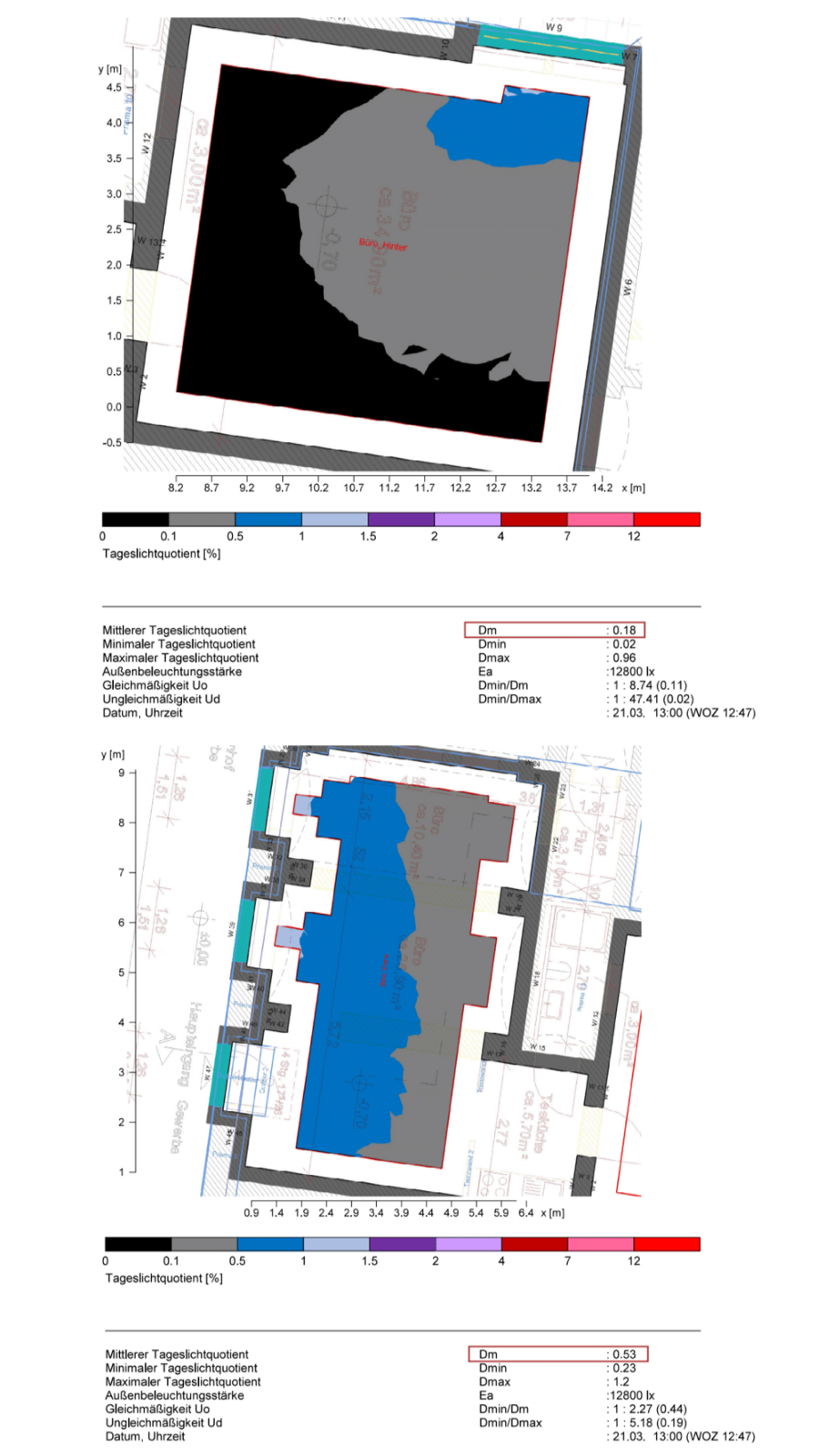
No workspace functions exclusively with natural light. What matters is the transition. This is exactly where the true quality of lighting design begins. Artificial light takes over where daylight weakens, changes over the course of the day, or is no longer sufficient in deeper zones of the space. It stabilizes the lighting atmosphere and ensures continuity without altering the character of the space or drawing attention to itself.
This example makes clear how sensitively this dialogue must be designed. Different usage zones, changing times of day, and long periods of occupancy require a lighting concept that not only reacts, but anticipates. Daylight forms the foundation of spatial perception. Artificial light complements it where necessary – calm, precise, and restrained.
What is particularly important in this process:
• clear transitions without harsh breaks
• even brightness gradients throughout the day
• calm light distribution in circulation and work areas
• stability of the lighting atmosphere despite changing use
Ideally, the shift between light sources remains almost unnoticed. No sudden changes in mood, no visible switching. Instead, flowing transitions emerge that support the natural rhythm of the day:
• in the morning, artificial light subtly supports the available daylight
• at midday, it balances and stabilizes
• in the evening, it takes on an orienting and atmospheric role
In this way, spaces retain their clarity regardless of time of day or season. Light is not understood as a technical tool, but as an atmospheric framework that enables and supports use. Visual unrest is avoided, perception is eased.
Especially in more complex projects, daylight studies reveal how crucial this coordination is. They make visible:
• how natural light is distributed throughout the space
• which zones are consistently well supplied
• where artificial light should provide targeted support
• how lighting atmospheres change over the course of the day
Not as a replacement for daylight, but as its dialogue partner. This is how lighting concepts emerge that function sustainably over time and are not tied to a single moment or a specific mood.
“Daylight studies reveal what defines good spaces: flowing transitions, stable lighting atmospheres, and an interplay that supports people without drawing attention to itself.”
Why Working with Studio De Schutter Makes the Difference
Well-planned daylight in the office does not happen by chance. It is the result of experience, sensitivity, and precise planning. Studio De Schutter understands daylight not as a secondary consideration, but as a central design element. We always think of light in relation to space, use, and atmosphere.

As lighting designers, we develop concepts that make workspaces not only functional, but perceptibly better. Because light should not simply be present. It should be allowed to have an effect.
Contact Us:
