

At night, a roof terrace has one advantage that almost no other outdoor space has:
darkness itself.
Sky. City lights. Silhouettes. Distance.
That is exactly why the most common mistake is surprisingly simple: too much light.
Good roof terrace lighting does not try to bring daylight back.
It reveals just enough for use, orientation and architecture to work – without losing the night.
the terrace.
Light what
happens
there.
A roof terrace is not one single functional area.
It consists of several smaller situations.
Arriving. Sitting. Eating. Talking. Planting. Looking out.
Each of them needs different light.
The dining table can be clearly visible without making the entire roof surface bright.
A route needs orientation, but not a beam of light like a driveway.
A seating area needs faces and materials. Not necessarily a bright floor.
And the view across the city?
Above all, it needs one thing: as little disturbing light as possible within the field of view.
and you lose it.
On a roof terrace, much of the quality lies beyond the property line.
Sky. Rooftops. Tree canopies. City.
Bright light sources at eye level make these distant layers harder to see.
The eye adapts to the brighter foreground. The night beyond loses contrast.
Visible light sources along the most important sightlines should therefore remain as restrained as possible.
It is usually better to put light onto the surfaces that are actually being used.
The simplest way to light a roof terrace better:
Do not think in luminaires. Think in tasks.
The transition from the brighter interior to the exterior should be legible without creating a source of glare directly beside the door.
Faces, table surfaces and materials need soft, controlled light at the height where people actually use the space.
Steps, edges and routes need to remain understandable. Usually, this requires less light than expected.
A wall, plant or architectural surface can create depth without making the entire exterior space brighter.
Not every element needs light. Deliberately dark areas protect the view and preserve the character of the night.
Outdoors, lighting is often placed almost automatically on walls, façades or at the highest possible point.
That can work.
But it does not have to.
On a roof terrace in particular, light at a lower level can be considerably more comfortable.
Beneath a bench. On a low wall. At the table. Between plants. Within a step.
This keeps the light source closer to the actual task.
Less light then has to travel over greater distances.
Light at steps, edges or beneath furniture can support movement without making the entire terrace visible.
Light at table, seating and face level creates intimacy and supports conversation far better than brightness on the floor alone.
A single wall or planted surface in the background can give the outdoor space a stronger sense of enclosure.
glass becomes
a mirror.
A roof terrace is not only experienced from outside.
It is often viewed from the interior for hours.
This changes the lighting design completely.
As soon as it is dark outside and brighter indoors, the glazing begins to reflect the interior.
Bright pendants, exposed LEDs or strong points of light can multiply across the glass.
The image of the terrace changes completely.
Interior and exterior lighting should therefore never be planned independently from one another.
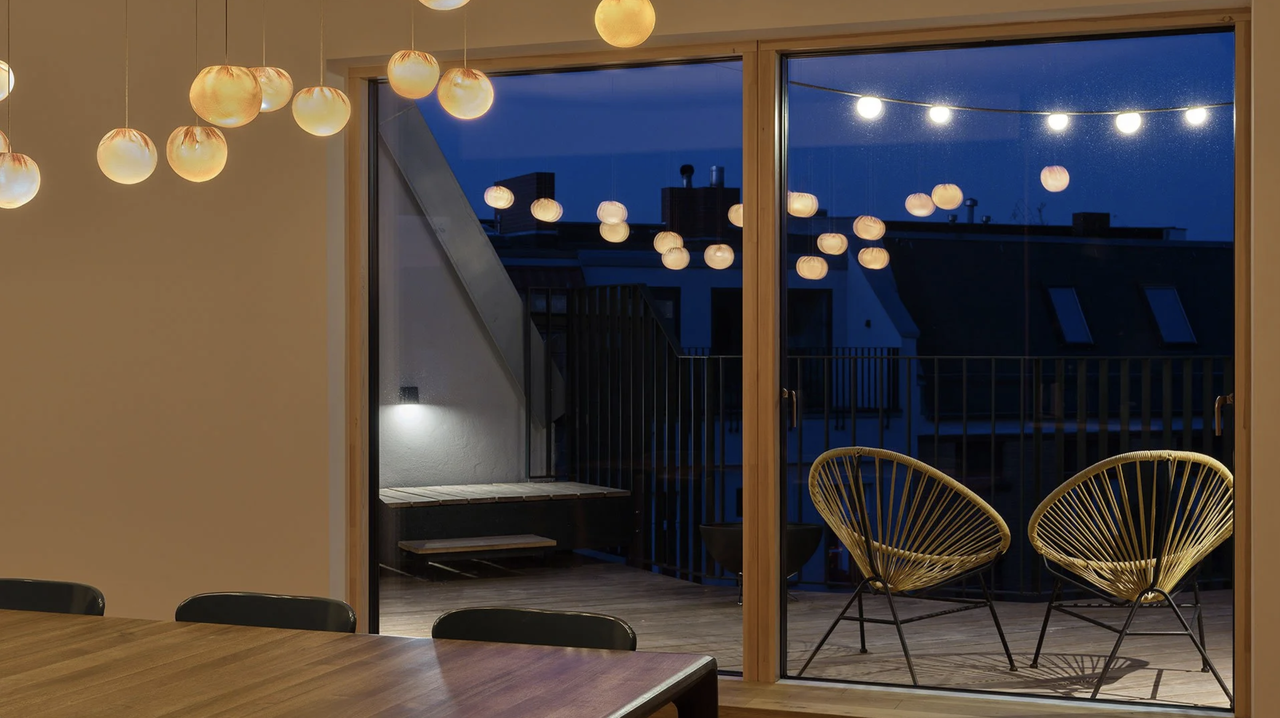
The Inselstraße image illustrates this relationship particularly well: interior lighting, reflections, exterior light and the darker city background all sit within the same field of view.
Small decorative points of light can suit a roof terrace very well.
They create scale. They define a place to sit. And they bring light closer to the use.
But the same rule still applies:
visible light sources remain visible.
If they are too bright, too cool or positioned directly within the most important sightline, they can disturb the view more than a well-shielded architectural luminaire.
The type of luminaire does not determine quality. Its brightness, position and relationship to the rest of the space do.
Colour temperature matters.
But a glaring light source still glares, even at 2700 K.
For a comfortable roof terrace, at least equally important are:
- shielding
- dimming
- mounting height
- viewing direction
- contrast with the surroundings
- materials and surfaces
Warm is a colour temperature. Comfortable is a combination of factors.
A common mistake in terrace lighting: almost all the light lands horizontally.
Floor. Table. Floor. More floor.
Yet we read an exterior space strongly through its vertical boundaries.
A softly illuminated wall can provide more spatial orientation than several additional floor lights.
Planting can create depth too.
But not every plant needs its own spotlight.
A background works better when not every detail is equally important.
construction changes
the light.
Rain, moisture and temperature fluctuations vary depending on the exact position. Luminaires and components therefore need to be suitable for the real exterior application.
Seating positions, neighbouring buildings, interior rooms and movement across the terrace should all be considered when aiming the light.
Drivers, connections and integrated light sources should remain reasonably accessible later.
Dining, conversation, late evening and simple orientation may all require different dimming levels or lighting groups.
The beginning of an evening is not the same as midnight.
During dinner, the table may need to be more clearly illuminated.
Later, accents can be reduced. Landscape or decorative lighting can disappear. Only orientation remains.
This is where dimming becomes particularly valuable.
Not as a technical extra.
But because the function of the terrace changes.
answer these questions.
- Where do people actually sit?
- Which views should remain visible after dark?
- Which light sources sit directly within the field of view?
- Where are there steps, edges or changes in level?
- Which surface could become a calm background?
- What does the terrace look like from inside through the glazing?
- Which interior lights reflect in the glass at night?
- Which areas genuinely need light – and which can remain dark?
- Can the dining area be dimmed separately?
- Are the luminaires and components suitable for their actual exterior location?
- Will connections and technical components remain maintainable?
- Can the lighting be reduced significantly later in the evening?
- Making everything equally bright: this removes spatial hierarchy.
- Lighting only the floor: walls, plants and vertical surfaces can matter more for spatial depth.
- Ignoring the view: bright light sources in the foreground weaken the view into the night.
- Planning inside and outside separately: large glass surfaces connect both lighting environments after sunset.
- Using too many visible LEDs: small points of light can quickly build up into a dominant visual layer.
- Confusing warm white with glare control: the direction of the light still matters.
- Skipping dimming: a late evening usually needs considerably less light than dinner at dusk.
- Trying to hide technology afterwards: exterior connections, drainage, installation and maintenance should be considered early.
A combination of restrained orientation lighting, light for seating or dining areas and a few accents on vertical surfaces or planting is usually effective. One uniform layer of general lighting is rarely the most interesting solution.
There is no single value that works for every terrace. Use, surroundings, materials, sightlines and the existing brightness of the city all vary considerably. A clear hierarchy between functional areas and deliberately darker zones is more important.
Warm light can work well in residential and hospitality settings. Colour temperature should, however, always be considered together with dimming, materials, colour rendering and the adjacent interior.
They can define a seating area pleasantly and bring light closer to human scale. Brightness, position, glare and whether the visible points of light interfere with important views remain decisive.
Light sources should be checked from typical seating and viewing positions. Good shielding, lower mounting heights, precise aiming and reduced brightness can often achieve more than adding further luminaires.
Large glass surfaces reflect bright interior luminaires at night. Pendants and other light sources can therefore overlay the view of the terrace and the city beyond. Interior and exterior lighting should be considered as one nocturnal image.
Dimming is particularly useful because the way the terrace is used changes throughout the evening. Light for dining or arrival can later be reduced until only restrained orientation lighting remains.
light.
More night
with the
right light.
Where will people sit? What should remain visible? Which view must not be lost? And how does the exterior space change when the interior lighting is switched on?
Studio De Schutter develops exterior lighting from use, architecture, sightlines and darkness.
Because on a roof terrace in particular, darkness is not a problem that needs to be completely solved.
It is part of the design.
Contact Us:
