

Natural stone does not need light to be interesting.
But light determines which part of its story we see.
A rough surface can appear almost flat. An inconspicuous joint can suddenly feel deep. A projection only a few millimetres high can cast a shadow that changes the entire wall.
When lighting a natural stone wall, the first thing to design is therefore not brightness. It is relief, direction and shadow.
Stone visible.
Light from the side.
Stone dimensional.
A natural stone surface is not defined by colour alone.
It consists of projections, recesses, joints, edges, inclusions and different levels of reflection.
The flatter the light travels across the surface, the longer the shadows can become.
And it is precisely these shadows that make relief visible.
of grazing light along
a textured stone wall
Three completely different effects.
When the luminaire is positioned very close to the wall, the light strikes the surface at a shallow angle. Small projections cast pronounced shadows. Rough natural stone appears more sculptural and dramatic.
As the distance increases, the shadows become shorter. The material remains visible, but appears calmer. For many interiors, this balance is exactly what makes the lighting work.
With more frontal lighting, the wall becomes more evenly illuminated. The material colour moves into the foreground, while joints and irregularities visually recede.
The luminaire sits close to the surface. The light travels along the wall at a sharp angle.
This creates light and shadow directly at joints, projections and irregular stone surfaces.
- strong material expression
- pronounced relief
- stronger shadows
- ideal for deliberately textured surfaces
Wallwashers are positioned further away from the wall and distribute light more evenly across the vertical surface.
This can be useful when a natural stone wall should act as a calm spatial backdrop rather than highlighting every irregularity.
- more even brightness
- reduced shadow effect
- calmer overall appearance
- greater emphasis on surface and colour
Neither.
The question is: What should the wall communicate?
If roughly hewn stone should reveal its irregularity, grazing light is often the stronger tool.
If a large wall should appear calm, refined and coherent, a more even vertical illumination may be the better choice.
And sometimes the best solution lies exactly between these two extremes.
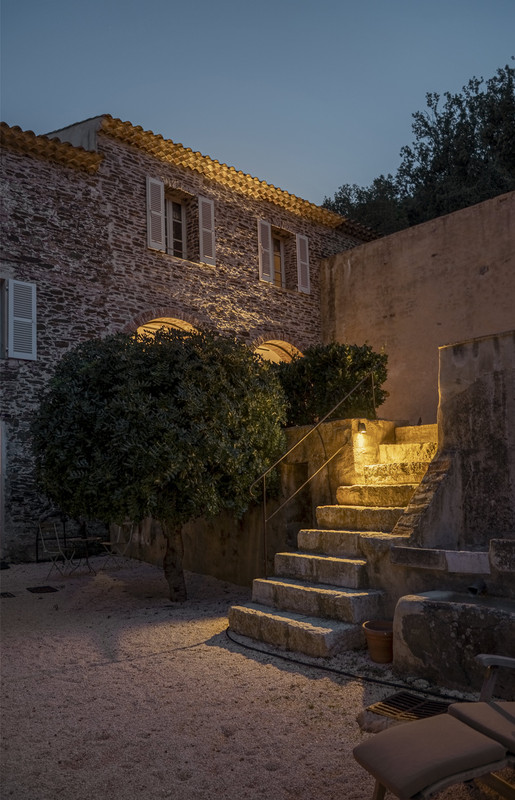
Bénat
Château Bénat shows particularly well why natural stone lighting should not begin with as much light as possible.
The historic estate on the French Riviera is defined by age, irregularities, local materials and deliberately preserved darkness.
In the exterior spaces, walls, paths, stairs, trees and architectural elements were considered individually.
The aim was not to make every surface visible. It was to reveal exactly the right amount of material information.
Luminaire second.
Even small projections cast pronounced shadows under shallow light. Grazing light can be especially powerful here – but it can also become too dramatic very quickly.
With more subtle surfaces, distance becomes even more important. Lighting that is too frontal removes depth, while extreme grazing light can exaggerate minor irregularities.
Here, attention shifts from relief to colour, veining and pattern. More even illumination can become more important than strong shadows.
Highly polished stone surfaces can reflect luminaires and bright areas. Viewing angle and glare therefore need to be considered as carefully as brightness itself.
There is no universal answer here either.
Warm light can make beige, reddish, sandy and many historic stone surfaces appear especially rich.
A cooler stone, however, may lose some of its neutrality under the same colour temperature.
The colour rendering of the light source also matters.
A high-quality material should not be viewed under a spectrum that unnecessarily reduces its natural colour nuances.
The right colour temperature is therefore not a stylistic choice made from a catalogue. It should be tested with the actual stone.
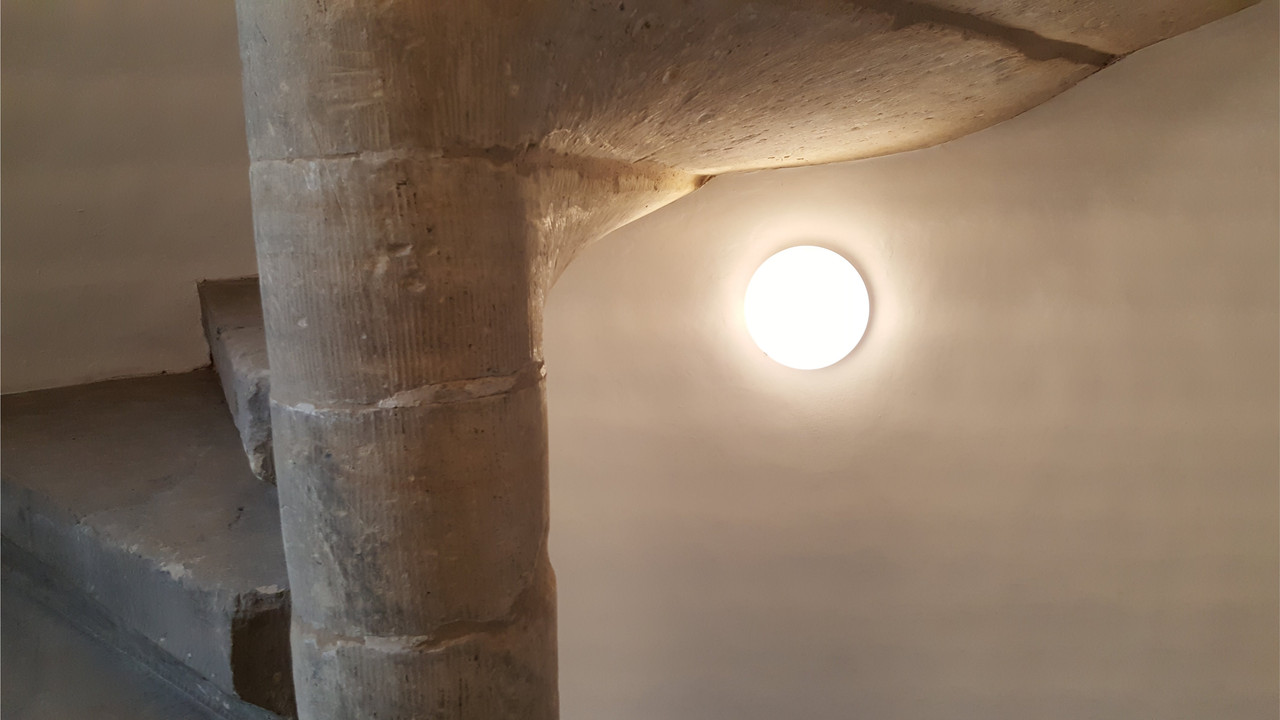
means treating every detail differently.
On a textured interior wall, a close and directional light source can make small projections and joints visible. The key question is whether the wall should act as a calm backdrop or as an architectural element in its own right.
Château Bénat demonstrates how individual points of light and low light levels can make historic stone architecture legible without losing its irregularity or the surrounding darkness.
On stairs, material expression and orientation come together. Light can reveal stone edges, changes in level and the direction of movement without illuminating the staircase like a stage.
In historic buildings, the question of the most attractive lighting effect is not enough. Mounting, existing electrical points, interventions in the building fabric and heritage requirements have to be resolved together.
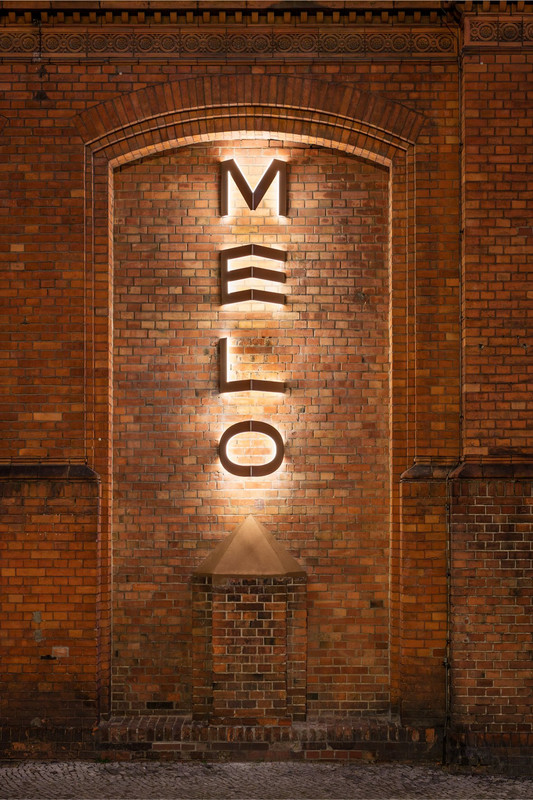
Brick also has joints and relief, but reacts differently from natural stone. MELO shows how a warm glow can reveal a historic brick façade without illuminating the entire building surface uniformly.
With finely honed or large-format slabs, the material pattern can matter more than shadow. In these cases, calmer and more even illumination can be more interesting than extreme grazing light.
rough wall
is natural stone.
This distinction matters in good lighting design.
Natural stone. Brick. Historic plaster. Concrete. Terracotta.
They may appear similarly textured in photographs and still react very differently to light.
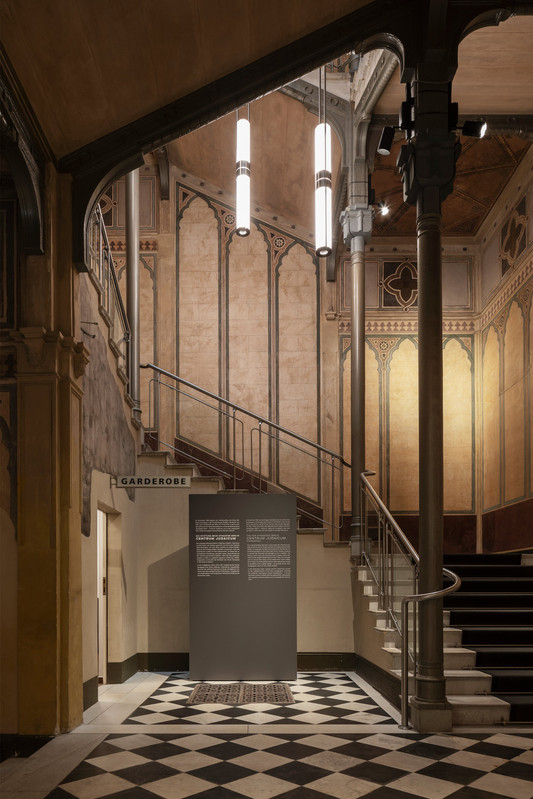
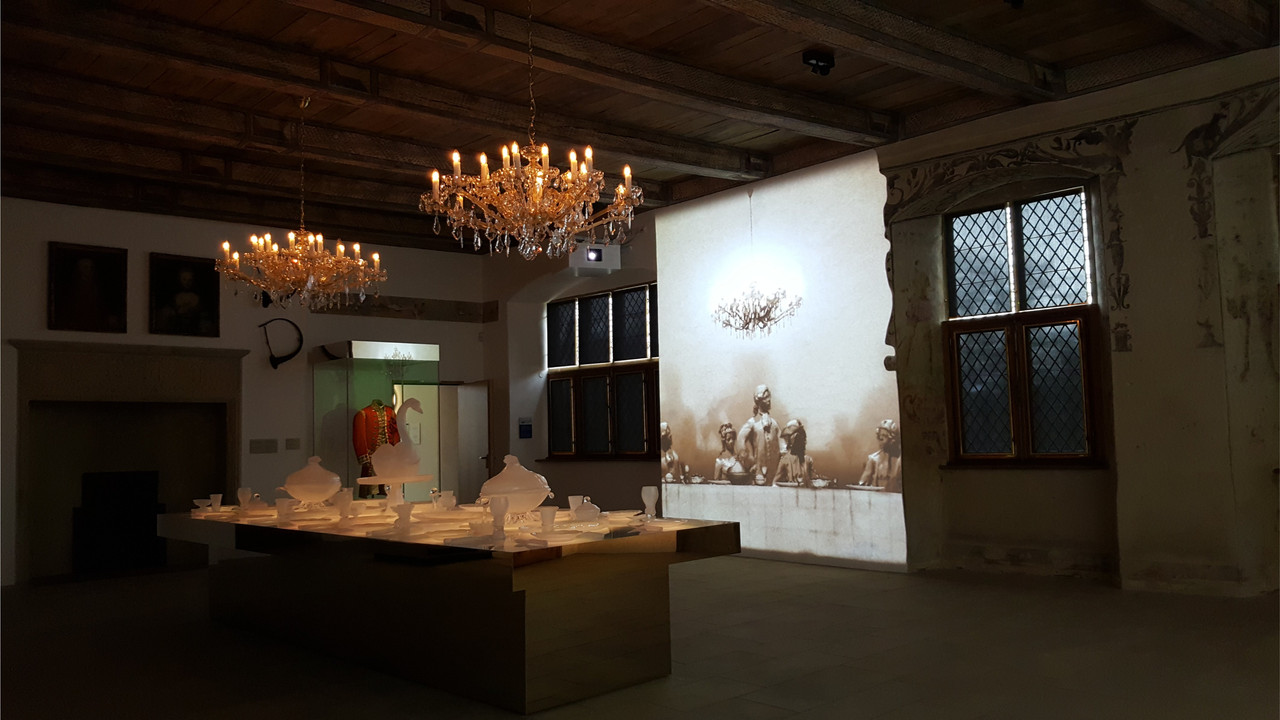
At Centrum Judaicum, for example, the historic architecture itself became part of the exhibition. The lighting had to reveal historic details while mounting and technology respected the protected building fabric.
This is directly relevant to natural stone projects: the surface determines not only the lighting effect. It also determines how and where light can be integrated at all.
In masonry and natural stone, the strongest shadows often do not sit on the surface.
They sit in between.
In the joints. Beneath projecting edges. Between stones set at different depths.
When the wall is illuminated frontally, these differences in depth partly disappear.
When the light comes from the side, they become graphic.
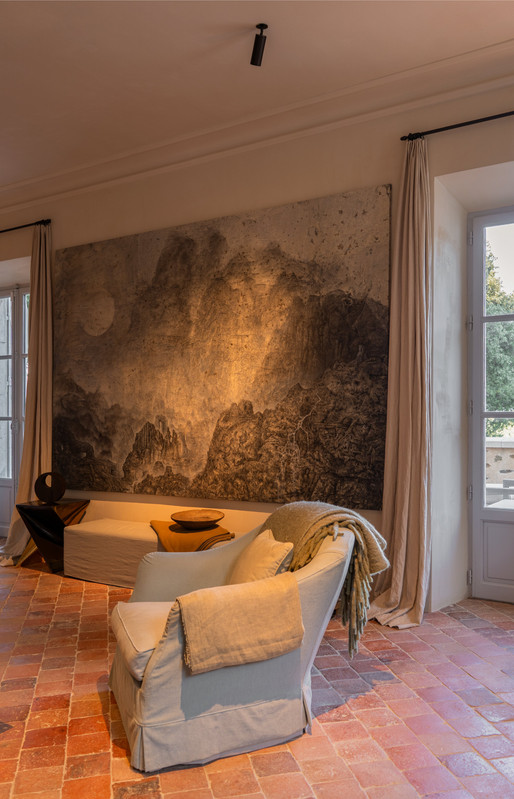
In many projects, it happens the other way around.
The luminaires are fixed. The distances are fixed. The ceiling is closed.
Then the natural stone wall arrives.
But a strongly profiled rubble stone wall requires a different lighting geometry from a calm limestone slab.
A light stone surface reacts differently from dark basalt.
Polished marble differently from open-pored travertine.
Ideally, material, desired effect, optics and luminaire position should therefore be developed together.
Indoors, the luminaire position can often be controlled very precisely.
Outdoors, additional layers come into play:
- weather exposure and suitable protection ratings
- drainage for ground-level or recessed luminaires
- dirt on optics and glass surfaces
- glare for neighbours and passers-by
- light spill and unnecessary light into the night sky
- vegetation that can alter the light path over time
- maintenance accessibility
An exterior natural stone façade is therefore not simply an enlarged living-room detail.
It needs its own lighting strategy.
But the light makes it look flat.
Relief loses its shadows and therefore much of its three-dimensional character.
Not every wall benefits from maximum emphasis on irregularities. With calmer stone, extreme texture can even become distracting.
Colour temperature alone does not determine how a material appears. Colour rendering and spectrum matter too.
Joints and projections are often exactly what create the shadows that give a natural stone wall its depth.
High brightness does not automatically make a surface more interesting. It can even reduce contrast and material depth.
The real stone, the real joint and the actual lighting angle reveal more than a visualisation.
Natural stone is not a perfectly reproducible material.
Colour, pores, veins, relief and surface treatment all vary.
That is precisely why lighting decisions should not be made from a rendering alone.
A mock-up can answer very quickly:
- How long do the shadows become?
- Do the joints become too dominant?
- Is the wall sufficiently even?
- Are hotspots appearing?
- Is the light source visible from normal viewing angles?
- How does the material colour change?
- What happens when the light is dimmed?
At Château Bénat, this on-site work was part of the process: exterior spaces were not only planned through drawings, but fine-tuned through tests and observation in the real night-time environment.
before positioning the luminaires.
- Is the material actually natural stone – and what kind of surface is it?
- Is the stone rough, sawn, honed or polished?
- Should relief be emphasised, or rather colour and veining?
- Are the joints part of the desired effect?
- How close can the light source be positioned to the wall?
- Is grazing light or a more even wallwash more appropriate?
- From which viewing angles will the wall be seen?
- Could the luminaire itself cause glare or appear in reflections?
- Which colour temperature supports the actual material tone?
- Is high colour rendering important?
- Should the lighting be dimmable?
- For exterior use, is the solution suitable for the actual installation conditions?
- Will luminaires, drivers and connections remain accessible for maintenance?
- Has a sample been tested with the real material?
It depends on the desired effect and the surface. If the relief should be clearly visible, lighting that travels at a shallow angle along the wall is often effective. If the surface should appear calmer and more even, a greater distance from the wall may be more suitable.
With grazing light, the light source is positioned relatively close to the wall. The light strikes the surface at a shallow angle, causing projections and joints to cast shadows. This makes the three-dimensional structure of the natural stone more visible.
Grazing light emphasises surface texture and relief. Wallwashing uses a greater distance from the wall and aims for more even vertical brightness. Grazing light can be interesting for strongly textured natural stone, while wallwashing creates a calmer overall appearance.
There is no universally correct colour temperature. Warm light can support beige, sandy or reddish stone, while other materials may appear more authentic under more neutral light. Testing with the actual material is recommended.
Yes. Lighting from below can strongly emphasise relief and height. At the same time, glare, hotspots, dirt and maintenance of ground-level luminaires need to be considered. Outdoors, the entire installation situation must also be technically suitable.
There is no universal distance. The closer the light source is to the wall, the more strongly the relief can be emphasised. Optics, beam angle, wall height, stone texture and the desired uniformity all need to be considered together.
Depending on the architecture, ground-mounted spotlights, linear solutions, wallwashers or precisely positioned accent luminaires can all be suitable. In addition to the lighting effect, glare, light spill, maintenance, weather exposure and architectural integration are important.
No. Textured stone often benefits from contrast and shadow. Excessive or overly uniform brightness can make the surface appear visually flatter. The key is not maximum brightness, but the right light distribution.
has depth.
Light only has
to make it
visible.
How rough is the surface? Which joints should remain visible? Should the wall feel calm or dramatic? How does the stone change from different viewing angles?
Studio De Schutter develops lighting concepts for historic and contemporary materials in interior and exterior spaces – from the first lighting idea to mock-ups and fine-tuning on site.
Because not every natural stone wall needs more light.
Some only need the right angle.
Contact Us:
