

Understanding Modern Lighting Design: Between Function, Comfort, and Architecture
Modern lighting design does not begin with choosing beautiful luminaires, but with one simple question: What should actually be possible in this space?
Good lighting must support visual tasks safely, make rooms feel pleasant and glare-free, make architecture readable, and at the same time remain efficient, controllable, and easy to maintain over the long term.
This is exactly why contemporary lighting design always thinks in layers: daylight, ambient light, task light, accent light, control, and material effect belong together.
For indoor workplaces, the most relevant foundations are the technical planning standard DIN EN 12464-1 and, in Germany, the occupational safety-related ASR A3.4.
For homes and small offices, the same principle applies in practice, only with a different emphasis: in living spaces, atmosphere, flexibility, and material effect move more into the foreground; in home offices, studios, or small practices, illuminance, glare control, screen suitability, and daylight guidance become more important.
.jpg)
Light influences not only vision, but also wellbeing and the daily rhythm. The DGUV describes that every light entering the eye triggers non-visual effects, that daylight stabilizes the internal clock, and that large, rather diffuse light sources in the upper field of vision can produce stronger non-visual effects.
Those who proceed in this order usually achieve better spaces with less technical stress, fewer wrong purchases, and often lower energy demand.
Quick Checklist What should be clarified before selecting any luminaire- Clarify activities: Which activities take place here, at what times of day, and exactly where in the room?
- Observe daylight: Check window orientation, views to the outside, glare on screens, glossy surfaces, and shading.
- Plan three layers: Ambient light, task-specific light, and accent or mood light.
- Do not just buy brightness: Pay attention to dimmability, low flicker, good colour rendering, and sensible glare control.
- Check critical zones: A lux meter is more reliable than a phone app, which only provides approximate values.
.jpg)
The real value of modern lighting design lies in resolving contradictions.
A space should be bright enough for work, but not feel clinical in the evening. A kitchen should be safely and precisely lit, but still feel warm and comfortable when dining. A small office should function professionally without looking like a standard grid from an administrative building.
Good planning does not solve this with “more light”, but with the right light in the right place at the right time.
DIN EN 12464-1 addresses not only illuminance, but the entire lighting environment, including luminance distribution, glare, light direction, light colour, colour rendering, flicker, and daylight.
For residential spaces, the three-layer principle is particularly helpful. Ambient light creates basic brightness, zone lighting supports activities such as reading, dining, or working, and mood light creates depth and spatial differentiation.
This is exactly why the classic solution of “one beautiful luminaire in the centre of the room” is often no longer enough.
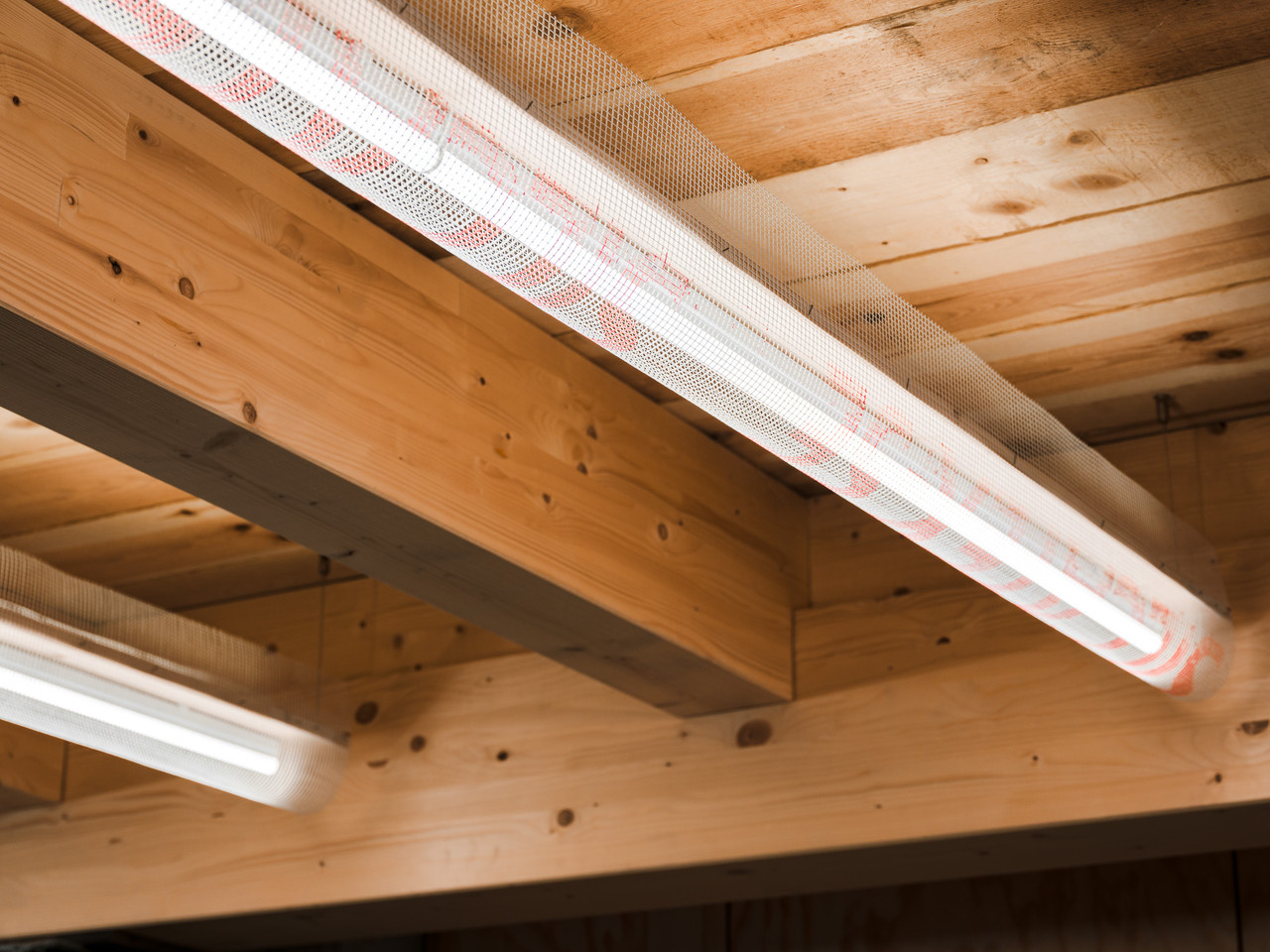
As soon as a room is used in a work-like way, the relevant normative foundations should be understood. For workplaces, ASR A3.4 specifies the German Workplace Ordinance.
Functionally, everything begins with the visual task. Not every surface has to be equally bright. For typical office and screen work, 500 lux on the work surface is a meaningful reference value; around the workplace, 300 lux is considered a good surrounding level.
This gradation prevents harsh jumps in brightness and unnecessary visual adaptation.
For typical residential situations, practical reference values help. In the kitchen, 500 lux or more is useful for safety reasons. Bathrooms often require stronger general lighting, stairs need clear orientation, and home office zones usually work better with serious task lighting.
These values are not an invitation to overlight, but a guide to where vision needs to function precisely, safely, or with less fatigue.
Comparison at a glance| Lighting type | Typical range | Use |
|---|---|---|
| Ambient light | approx. 100–300 lx in living and circulation areas, approx. 300–500 lx in work-related environments | Corridors, living room base lighting, bathroom base lighting, waiting areas, surrounding zones. |
| Task light | usually 500 lx, more for finer visual tasks | Desk, kitchen worktop, reading, mirror and inspection zones. |
| Accent light | often approx. 50–300 lx on the object or zone; the brightness contrast is decisive | Pictures, shelves, wall textures, art, orientation points, architectural details. |
.jpg)
Comfort begins with light colour, but it does not end there. Warm white is usually experienced as cosy, neutral white as more factual, and daylight white as cooler and more activating.
Important: light colour and colour rendering are not the same thing. Two luminaires with the same Kelvin value can render colours very differently.
For the daily rhythm, not only colour temperature is relevant, but above all the light that actually reaches the eye, at what time of day it does so, and from which direction in the room it comes.
Broken down practically: plenty of good daylight and sufficiently bright vertical surfaces during the day; warmer, dimmer, and calmer light in the evening.
Human-centric lighting can be useful, but it should not be mystified. It does not replace a window, intelligent furnishing, or glare protection.
Flicker-free light is an underestimated comfort factor. If dimming is planned, do not combine just any luminaire with just any dimmer. The dimmable system consisting of luminaire, driver, and control should be explicitly checked.
Architecture and Materiality Light organizes architectureLight does not only make architecture visible; it organizes it.
Ambient light makes the room readable, zone lighting shows where something happens, and accent lighting creates hierarchies. This results in spaces that are not only bright, but understandable.
Vertical surfaces
Wallwashing improves orientation, makes rooms appear more generous, and creates depth.
Materiality
Dark surfaces need more light. Bright surfaces improve visual comfort and energy efficiency.
Surfaces
Glass, polished stone, glossy tabletops, or screens can create reflected glare.
Direct light component
For reading, writing, or handwork, controlled directional light remains important.
Good architectural lighting is therefore almost always a deliberate mix of soft brightening and directed, controlled light components.
LED is now standard, but LED does not automatically mean good lighting design.
What matters are light colour, colour rendering, flicker, photobiological safety, and dimming behaviour. In practice, this means making conscious decisions about Kelvin, CRI, optics, and dimming behaviour instead of simply comparing wattages.
Sustainability is created not only through efficient light sources, but through demand-based control, maintenance, and replaceability.
For the implementation strategy, it is important to know that wireless solutions can be retrofitted comparatively easily; bus- and cable-based systems are especially interesting for new builds and complete refurbishments, offering more integration freedom but requiring more effort for wiring and commissioning.
Implementation The right order makes the differenceTypical cost ranges are not specified here. This is not evasion, but honesty: whether a project is an apartment refurbishment with wireless retrofitting, a new-build single-family house, or a small existing practice changes the costs massively.
- Clarify use and times of day
- Determine visual tasks and relevant standards
- Check daylight, glare, and materials
- Define lighting zones and luminaire types
- Define control, scenes, and sensors
- Secure installation, commissioning, and maintenance
Those who truly think function, comfort, and architecture together create spaces that look better, work better, and feel better.
And almost always, it becomes clear: it is not the most expensive luminaire that makes the difference, but the smartest combination of daylight, zones, glare control, control systems, and material awareness.

Contact Us:
