

Lobby Lighting: How Light Shapes a Building's First Impression
A lobby is not a neutral space. It is the first moment a building begins to speak. Before anyone reaches reception, before a conversation begins, before a name is spoken.
Good lobby lighting decides whether arriving feels ordinary or valuable. Whether a space gives orientation. Whether materials gain depth. Whether reception is visible without becoming harsh. Whether architecture becomes present without imposing itself.
.jpg)
The most common mistake isn't too little light. It's too little hierarchy.
Everything is equally bright. Nothing leads the eye. The space loses its sense of direction.
Several tasks meet in a lobby at once. It has to represent. It has to guide. It has to provide a sense of security. It has to hold waiting, welcoming, distributing and sometimes calming, all at once.
That's what makes lighting design here demanding. A lobby is often a passage and a place to linger at the same time. People arrive from outside. Eyes need to adjust. Reception has to be easy to find. Routes have to feel intuitive.
At the same time, the space can't read as a purely functional circulation zone. It needs depth. Materiality. Contrast. A moment of arrival.
Not spectacular.
Precise.
Often it isn't really about a single fixture. Nor just about how many spotlights are needed.
What's usually being sought is a solution for a space that matters but is hard to pin down. A hotel lobby. An office lobby. A reception area. A foyer. An entrance space that has to do more than simply be bright.
The real question is: How does an entrance become a convincing first impression?
Guests need to instantly understand where to go. Reception, elevators, lounge and transitions all need a clear lighting logic.
Materials only read as high quality when light brings out surfaces, edges and depth correctly.
A lobby isn't always just a passageway. It can become a meeting point, a waiting area and a social space.
Light decides whether a building feels distant or approachable.
A lobby begins at the threshold. The transition from outside to inside is a sensitive one: daylight, glass surfaces, reflective floors, bright façades, dark evening hours, seasonal shifts.
Professional lighting design accounts for that shift. Not just the lobby itself. But the moment before it. And the path that follows.
Every lobby needs a visual sequence. Without one, the space feels restless.
The eye jumps around. Reception loses presence. Art and materials feel random. Seating areas feel like they're on display rather than lived in.
Good lobby lighting therefore doesn't build even brightness. It builds relationships:
- between entrance and reception
- between reception and the waiting zone
- between wall, ceiling, floor and object
- between daylight and artificial light
- between security and the quality of dwell time
Only once these relationships are right does the space start to feel self-evident.
A good lobby isn't understood through individual fixtures. It's planned in layers.
Ambient light. Accent light. Vertical illumination. Reception. Circulation. Seating areas. Material surfaces. Art. Branding.
Quality doesn't come from a single element.
It comes from how they work together.
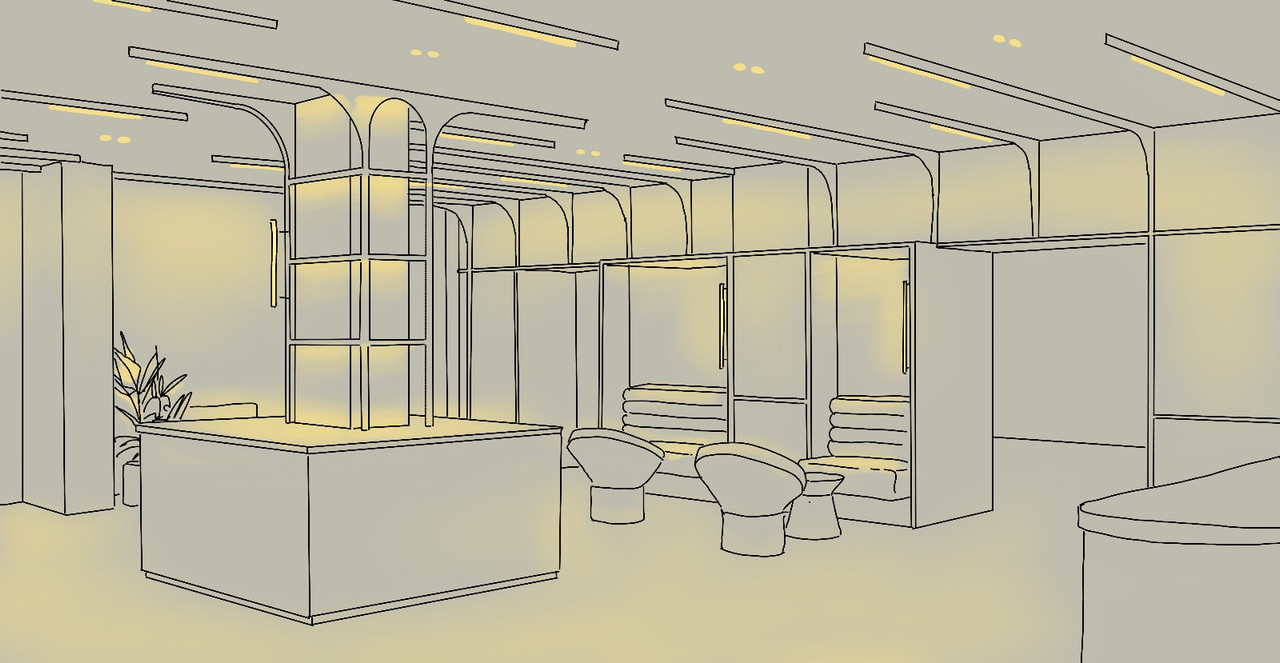
.jpg "Lighting design sketch for lobby, meeting area and orientation")
.jpg "Reception lighting concept sketch for lobby lighting design")
At the start of a lobby lighting project, it's not yet about a finished fixture schedule. It's about the logic of the space.
Where does the eye land first? Which surface carries the gaze onward? Where does reception need presence? Which areas can stay quieter? And where does the space need more depth without simply looking brighter?
This phase often produces simple sketches, lighting diagrams and spatial markers. Not as an end in themselves. But to clarify early on what effect the space should ultimately have.
This is especially critical for lobbies. Because here it's not just about standards, but about transitions. About sightlines. About the balance between openness and retreat. About the difference between an entrance and an arrival.
At COREUM Hotel, lobby and reception are shown connected through light.
Reception becomes visible without feeling harsh. The materials retain a sense of calm. The space feels open, but never arbitrary.
The lighting gives the act of arriving a sense of direction.
Many lobbies don't fail because of poor architecture. They fail because the lighting sets no priorities.
- too much even ceiling light
- too little vertical illumination on key surfaces
- glare at reception, glass or glossy surfaces
- no distinct lighting mood for evening and night operation
- no clear guidance toward elevators, reception or waiting zones
- decorative fixtures with no functional lighting effect
- coordination with interior design and electrical planning happening too late
The best lobby lighting doesn't feel added on. It feels as though the space needed it from the very start.
A lobby rarely works with a single type of light. It needs layers that work together.
Vertical light makes walls, reception areas and spatial boundaries visible. Without vertical brightness, lobbies quickly feel dark, even when the floor itself receives plenty of light.
Accent light directs attention. To art. To plants. To material details. To reception. To the places that are meant to be found.
Indirect light can create height, calm and generosity. But only when it's kept under control. Too much of it flattens a space.
Scene control matters especially when a lobby needs to feel different in the morning, during the day, in the evening and at night. A reception desk at 9 a.m. doesn't need the same lighting mood as a hotel lobby at 11 p.m.
Warm, welcoming, legible. The guest should arrive, orient themselves and immediately get a feel for the property.
Clear, professional, representative. Light supports brand, reception, security and everyday wayfinding.
Robust, intuitive, calm. Orientation, glare control and legibility of large spatial volumes matter most.
Lobby lighting shouldn't be chosen at the end of the process.
A collaboration with Studio De Schutter makes particular sense when an entrance area needs to do more than standard lighting: for hotels, office buildings, headquarters, public buildings, mixed-use projects or high-end reception areas.
Ideally, lighting design begins early. Before ceiling builds, power outlets, furnishing, reception desks and material choices are fully locked in.
Because the most important question isn't: which fixture fits?
It's: what lighting effect does this space actually need?
- Is reception instantly recognisable from the entrance?
- Are there clear lighting accents for routes, waiting zones and transitions?
- Are walls and vertical surfaces given adequate consideration?
- Does the space work in daylight, at dusk and at night?
- Are glossy surfaces, glass and screens planned to be glare-free?
- Does the light support the materials rather than distort them?
- Are there distinct scenes for operation, cleaning, events and night mode?
- Does the lighting feel architecturally integrated rather than added afterward?
Then light shouldn't be treated as a technical afterthought. In the very first space of a building, light determines orientation, perceived value and trust.
Studio De Schutter develops lighting concepts for lobbies, hotels, office buildings and high-end reception areas. Precisely planned. Architecturally integrated. Intuitive in daily operation.
For spaces that aren't just entered.
But remembered.
Contact Us:
