

A narrow recess. A concealed LED strip. A bright ceiling.
On plan, a lighting cove can look surprisingly simple.
In reality, every centimetre can decide whether the result is a calm luminous surface – or a visible row of bright points.
A good lighting cove is therefore less a luminaire than a precisely planned relationship between light source and architecture.
Surface visible.
Geometry decides.
A lighting cove is an architectural recess, projection or formed ceiling or wall detail in which a light source is concealed.
The light does not enter the room directly.
It first reaches an adjacent surface – often the ceiling – and is reflected from there back into the room.
The actual lighting effect therefore happens outside the cove.
That is exactly what makes it interesting.
One effect.
An LED strip or linear luminaire generates the light, ideally outside the direct field of view.
The architectural geometry shields the source and determines the angle at which the light leaves the detail.
Ceiling or wall reflect the light. Colour, texture and reflectance all change the result.
Only the reflected light becomes spatially effective and contributes to the brightness we actually perceive.
An LED strip can be hidden almost anywhere.
Behind furniture. Beneath a step. Inside a niche. Along an edge.
A lighting cove, by contrast, becomes part of the spatial construction.
Drywall, ceiling height, junction details and the final lighting effect are directly connected.
That is why it should not be designed only when the drywall contractor asks: “So where exactly should the LED strip go?”

A shadow gap is first of all an architectural detail: a deliberate separation between two building elements.
When light is integrated into it, this narrow separation can become a very precise line of light.
The gap itself often remains visually more important than the broad illumination of the ceiling.
In a lighting cove, the source is positioned so that wall or ceiling receive and reflect a larger proportion of the light.
The effect can therefore become broader, softer and spatially more significant.
In practice, the two principles can overlap depending on the construction.
This is the part that visualisations often leave out.
The same LED can look completely different in two different coves.
In one, the ceiling is illuminated calmly and almost evenly.
In the other: a bright stripe appears directly above the edge, followed by a darker surface.
The difference often does not lie in the LED. It lies in the construction around it.
is ordered.
Too far forward and the LED becomes visible from certain viewpoints. Too far back and part of the light remains trapped inside the construction.
The distance influences how broadly the light can spread and how strongly individual brightness zones become visible.
Its orientation determines whether mainly the edge glows or whether a larger area of ceiling becomes active.
Standing up, the source may be perfectly concealed. From a sofa, bed or meeting table, it may suddenly become visible.
One of the most common questions.
And one for which a universal centimetre value is surprisingly unhelpful.
The appropriate distance depends, among other things, on:
- the output and light distribution of the chosen source
- the position of the LED strip within the construction
- the width and height of the cove
- the distance to the reflecting surface
- surface colour and texture
- the desired width of the light gradient
- the most important viewing positions within the room
The more demanding the detail, the more valuable a mock-up becomes.
A small test installation can reveal more than ten technical drawings: Where does the light begin? Can the LED be seen? How softly does the brightness fade? What happens when the light is dimmed?
does not
have to create
only one
mood.
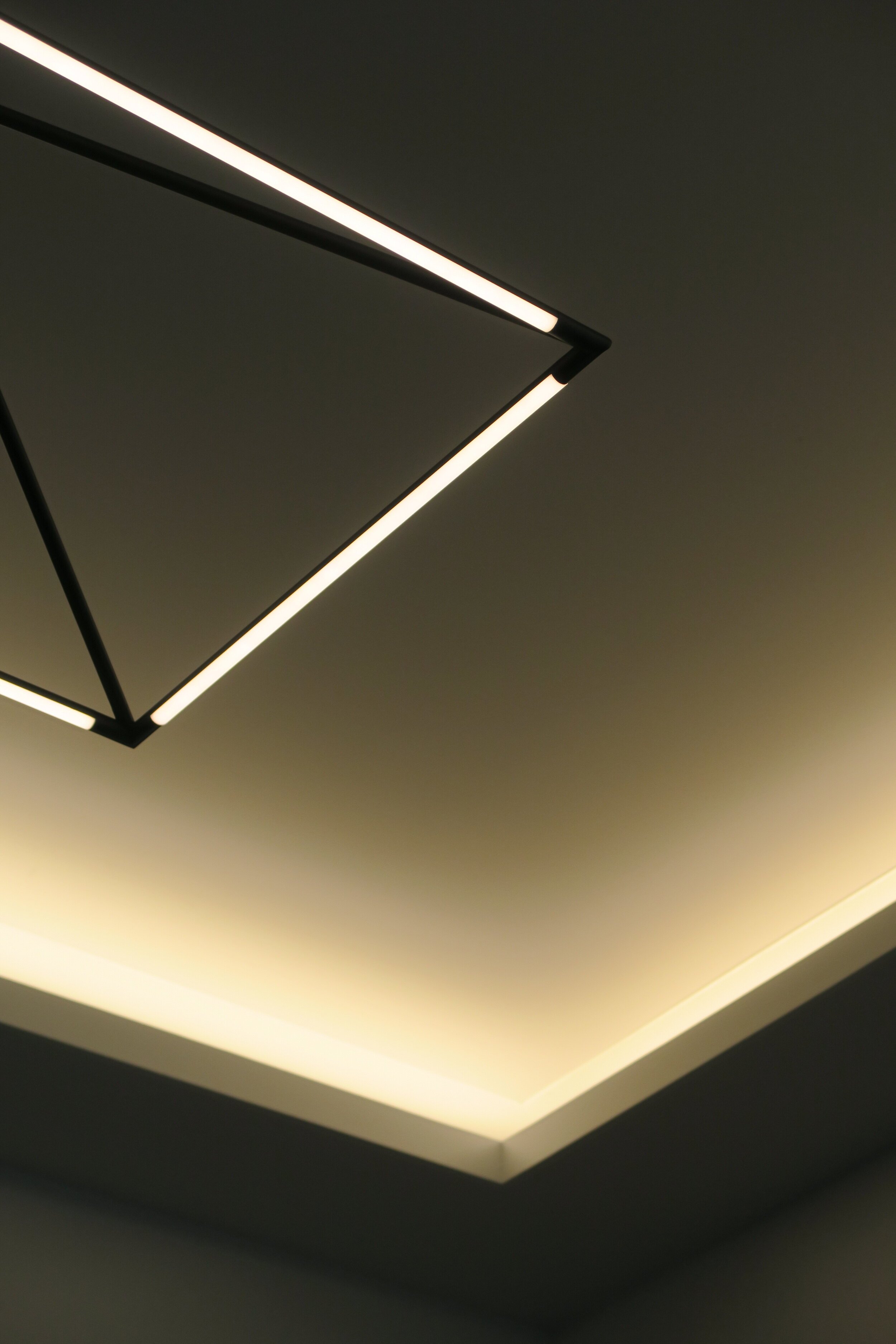
In the meeting room at Covivio Office in Berlin, indirect cove lighting is combined with visible, graphic pendant luminaires.
The two layers of light perform different tasks.
The pendant luminaires bring directed light into the room. The cove activates the ceiling surface and creates a softer layer of light in the background.
Particularly relevant: the lighting was designed for different use situations.
The luminaires are dimmable. Areas with dynamic lighting use programmed scenes.
This turns the cove from a static decorative element into a controllable part of the lighting concept.
The ceiling does not need to be at maximum brightness. Reduced indirect light can support screen contrast and visual calm.
Combining several lighting components can help faces appear more balanced than lighting exclusively from above.
A brighter indirect layer can increase the overall sense of brightness while the table remains selectively illuminated.
Reduced light levels change the character of the ceiling and the room without requiring a different luminaire.
This is probably the most persistent misconception about cove lighting.
The light source is concealed. So it cannot glare.
Unfortunately, it is not quite that simple.
A source may be concealed from a standing position and suddenly visible when seated.
A very bright ceiling against an otherwise dark room can create an uncomfortably strong contrast.
Glossy surfaces can reflect parts of the light source.
And if the geometry is too tight, very high brightness can occur directly at the cove edge.
But the room gains nothing.
The light source is defined before it is clear which surface should actually be illuminated and how.
This can create harsh brightness zones or make individual LED points visible on the reflecting surface.
A completely bright ceiling can quickly flatten the room and weaken other lighting accents.
White matt plaster reacts very differently from dark paint, concrete, timber or a glossy surface.
The most important viewing position may eventually be on a sofa, in bed or at a conference table.
Concealed LED technology, drivers and connections still need to remain accessible later.
The most interesting detail is often the one that deliberately stops.
When every edge of a room is fitted with indirect light, the result can quickly become one continuous bright outline.
The room loses hierarchy.
Instead, a cove can be used very selectively:
- above a seating area
- along an important wall
- at the transition between two spatial zones
- above a reception desk or counter
- in a meeting room
- in a bathroom
- where the ceiling height should become more legible
Not every edge needs light simply because there is technically enough space for it.
Indirect lighting is often associated with large, representative spaces.
Yet in smaller rooms it can be especially useful when no additional visible luminaire needs to come to the foreground.
In the bathroom at Eisenbahnstraße, cove lighting is combined with other lighting components.
The indirect layer complements spatial edges and surfaces instead of trying to perform every lighting task on its own.
That is a crucial distinction.
Good cove lighting does not automatically replace every form of direct light.
is one
lighting layer.
Not the
whole concept.
A cove can brighten a ceiling.
But it is rarely the most precise solution for a table.
It can soften spatial boundaries.
But it does not automatically illuminate an artwork well.
It can create calm ambient brightness.
But a face may need light from another direction.
The strongest concepts therefore often come from combining both.
Indirect light for surfaces and space. Direct light for use and accent.
before the drywall.
- Which surface should actually become brighter through the cove?
- Why does this particular edge need indirect light?
- What is the distance between light source and reflecting surface?
- Is the LED concealed from every relevant seated and standing position?
- Which surface will reflect the light?
- Is the light gradient soft enough or are hotspots appearing?
- Would a more diffuse profile or different LED arrangement perform better?
- How does the cove change when dimmed?
- Should the colour temperature remain static or be adjustable?
- Which direct light sources complement the indirect layer?
- Where are drivers and connections located?
- Will the technology remain accessible later?
- Would a mock-up be useful before final installation?
A lighting cove is an architectural recess or formed detail at a wall or ceiling in which a light source is concealed. The light first reaches an adjacent surface and is then reflected indirectly into the room.
A shadow gap primarily describes a deliberate separation between building elements. It can be combined with light. A lighting cove is more specifically designed to accommodate a concealed light source and direct light onto an adjacent surface. Depending on the construction, the two principles can overlap.
There is no universal distance that works for every cove. Light source, profile geometry, output, surface and desired light gradient all influence the result. For demanding details, a mock-up is often the safest method.
No. The source may be well concealed, but it still needs to be checked from every relevant viewing angle. High surface brightness and reflections can also create uncomfortable contrasts.
Light matt surfaces usually reflect light efficiently and evenly. Dark, textured or glossy materials can also be used, but they significantly change both the amount and character of the reflected light.
In many projects, dimming is very useful. An indirectly illuminated ceiling can feel completely different at full output than it does later in the evening at a reduced level. Dimming makes it possible to balance the cove with other lighting components.
It can provide a significant share of the overall spatial brightness. For precise visual tasks, accents or specific functional areas, additional direct or directional light is often still useful.
lighting cove
does not show
where the light
comes from.
How deep should the cove be? Which surface should it activate? From where must the light source remain completely invisible? And which direct lighting should complement it?
Studio De Schutter develops indirect lighting details together with architecture, use and materiality.
Because a good lighting cove does not begin with an LED strip.
It begins with a section through the space.
Contact Us:
